
Scientific publication does not end when an article is successfully published. How widely a study is read, cited, and influential within the academic community is an important aspect for researchers to understand. Therefore, the ability to measure and monitor research impact is becoming increasingly important in developing a strong research ecosystem. This was the focus of the Research Smarter Series #2: Measure, Track, and Elevate Your Research Impact with Scopus workshop, organized by the Library and Archives of Universitas Gadjah Mada (UGM) on Wednesday (19/8), held online.
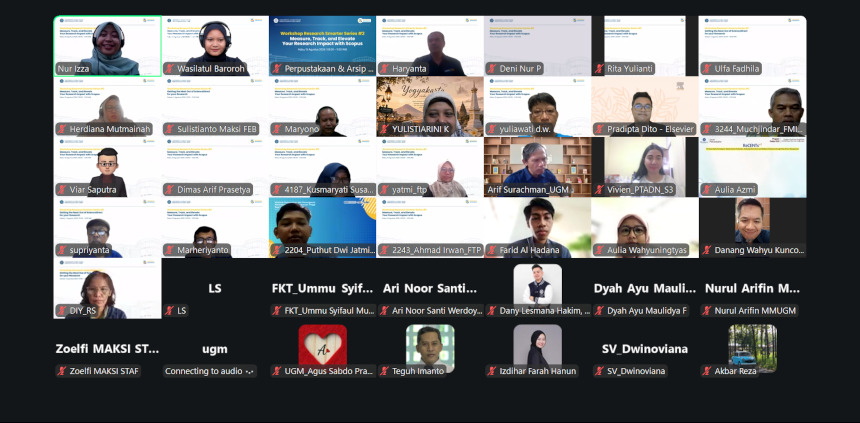 In his remarks, Head of the UGM Library and Archives, Arif Surachman, S.I.P., M.B.A., said that the UGM Library and Archives provides access to various scholarly databases to support the research and learning needs of the academic community. However, providing access to these resources is also accompanied by evaluations of their utilization.
“The UGM Library and Archives subscribes to various databases to support academic and research activities, one of which is Scopus. However, we also conduct evaluations as part of the process. One of the aspects we consider is how extensively these databases are used by the academic community, as this becomes one of the considerations in deciding whether the subscription should be continued,” said Arif.
The evaluation is part of the UGM Library and Archives’ efforts to ensure that the resources allocated to providing scholarly information sources are utilized optimally. Therefore, increasing the academic community’s understanding and use of these databases is an important part of maintaining the sustainability of information resource services.
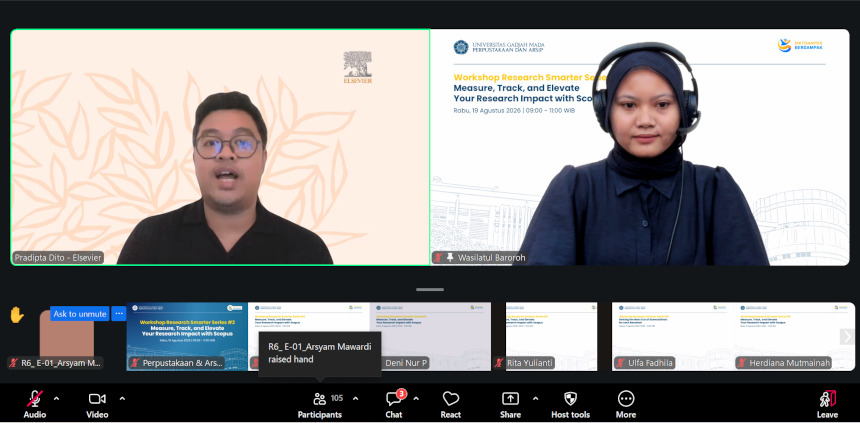
Moderated by Wasilatul Baroroh, a staff member of the UGM Library and Archives, the workshop featured Pradipta Faikar Hakim, Customer Success Manager, Elsevier South East Asia–Indonesia, as the speaker.
In his presentation, Pradipta explained various features available in Scopus and how they can be utilized to support research activities. He emphasized that Scopus is not only useful for searching for scholarly articles but also allows users to explore information about authors, organizations or institutions, and journals.
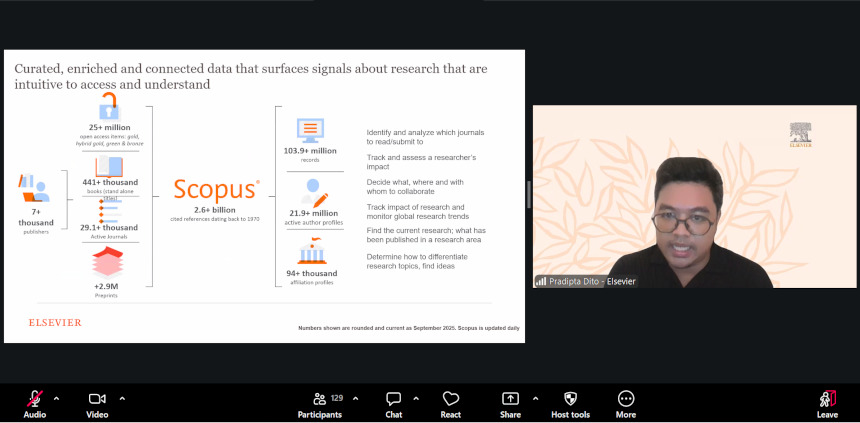 According to Pradipta, utilizing these various features allows researchers to examine research information from multiple perspectives, rather than focusing solely on published articles.
“In Scopus, we can search not only for articles, but also for authors, organizations, and journals. The information available in Scopus can therefore help us gain a deeper understanding of publications and research developments,” Pradipta explained.
These features can help researchers gain a broader overview of the scholarly publication ecosystem. Researchers can explore an author’s publication track record, examine connections between research and particular organizations, and identify journals relevant to their fields of study.
In addition to introducing Scopus features, Pradipta also explained how publication and citation information can be used to measure, monitor, and enhance research impact. Such information can serve as one of the resources researchers use to evaluate the development of their research and formulate future publication strategies.
The workshop also addressed an important aspect of scholarly publishing: publication ethics and predatory journals. Participants were encouraged to be more careful when selecting journals to publish their research and to understand the risks that may arise when publishing in journals that do not adhere to appropriate academic standards and practices.
 The workshop was not merely an introduction to a scholarly database. It was also part of an effort to strengthen information literacy and the academic community’s ability to make effective use of the research resources provided.
This initiative is aligned with the Sustainable Development Goals (SDGs), particularly SDG 4: Quality Education, by supporting the development of knowledge capacity and the quality of learning. It also contributes to SDG 9: Industry, Innovation and Infrastructure, through strengthening the research and innovation ecosystem and promoting the effective use of scholarly information infrastructure. In addition, the activity supports SDG 17: Partnerships for the Goals, by strengthening collaboration and networks between higher education institutions and scholarly information resource providers.
The more effectively scholarly databases are utilized, the greater the opportunity for information and research findings to be transformed into knowledge with meaningful impact. For the UGM Library and Archives, ensuring that access to scholarly information resources is used optimally is an important part of building a high-quality and sustainable research ecosystem.
Contributor: Wasilatul Baroroh