
Taking care of our health can start with simple things around us. One example is coconut, which is readily available at home and can be processed into Virgin Coconut Oil (VCO). This virgin coconut oil became an interesting topic at the Monthly Gathering of Universitas Gadjah Mada (UGM) Library and Archives on Friday (September 4), where participants learned about the experience of consuming VCO as well as how to make it at home.
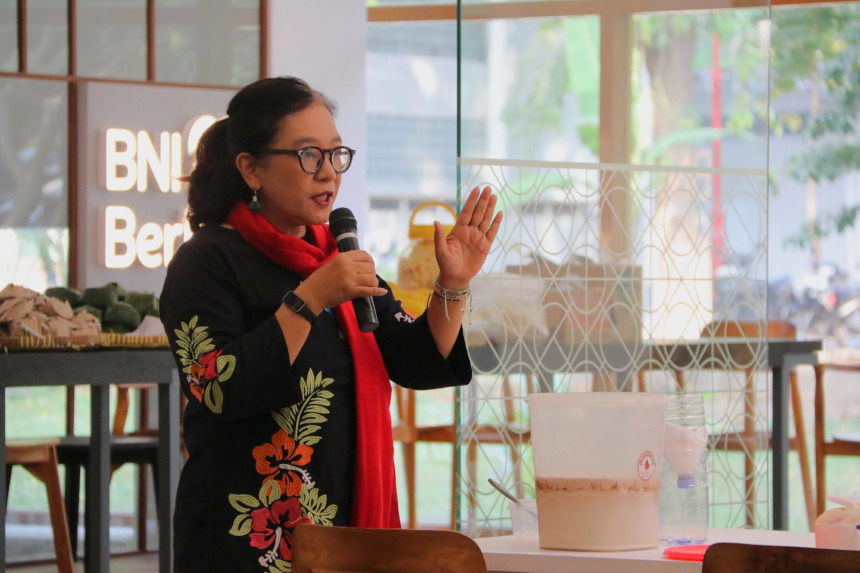 Held at the BNI Co-Working Space, L7 Building, 1st Floor, the session initiated by the Library Division invited participants to explore VCO from a perspective closely connected to everyday life. Rather than simply introducing the product, the session encouraged participants to see how a simple ingredient can be transformed into something valuable and used independently.
The session began with Lilik Kurniawati Uswah, S.E., M.Si., who shared her experience of consuming VCO daily. According to Lilik, this habit has brought several benefits she has personally experienced in her daily life, including improvements in her health, skin, and hair.
“I have been consuming VCO regularly every day. I have experienced many benefits, both for my health and for my skin and hair,” said Lilik.
Sharing her personal experience, Lilik also explained that she had benefited from VCO in supporting heart health and lowering cholesterol levels. Her experience became part of an informal discussion on personal choices and habits that can encourage greater attention to everyday health.
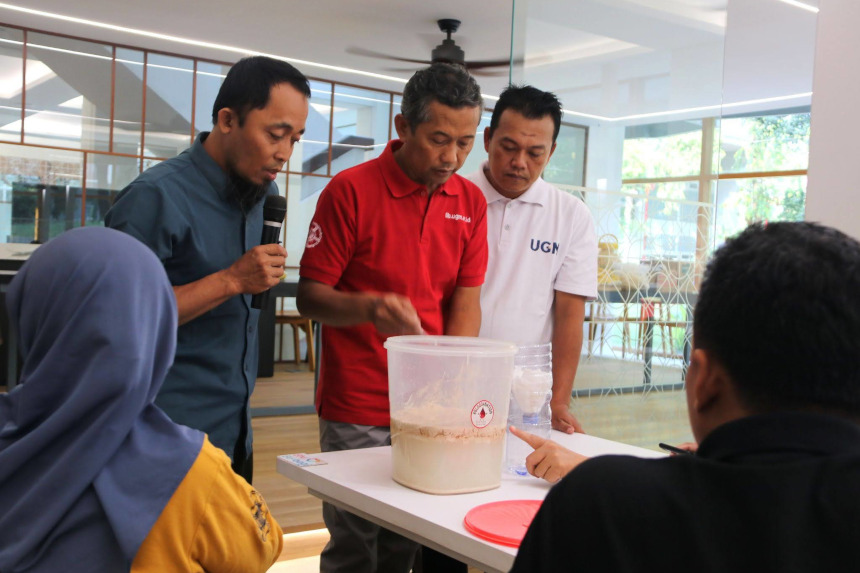 Next, Snuria Pusaka, A.Md., explained the simple steps for making VCO at home. She noted that making VCO independently can be an alternative to obtaining virgin coconut oil at a more affordable cost, particularly for people with access to mature coconuts.
“VCO is relatively expensive, so we can work around that by making it ourselves, especially if we have plenty of coconuts at home. The process is also quite simple,” explained Snuria.
The VCO-making process begins by grating mature coconut meat, mixing it with boiled water, and squeezing the mixture through a clean cloth to produce thick coconut milk. The coconut milk is then placed in a transparent container and left at room temperature for 12–24 hours until it separates into water and coconut cream, or blondo.
The water that settles at the bottom is then removed, while the coconut cream is transferred to a new container for a second settling process of approximately 24 hours. This process allows the oil to separate from the solid residue. The resulting oil is then collected and filtered through a funnel using tissue or cotton to obtain clearer VCO. The VCO is subsequently stored in an airtight bottle at room temperature.
Interestingly, the process need not end once the VCO has been obtained. The remaining materials can still be put to good use. The coconut pulp can be used for mopping floors, while the leftover blondo can be reprocessed to produce more oil. The remaining by-products from the oil-making process can even be used as food ingredients, such as ketak kelapa. In this way, every part of the coconut can be utilized to its fullest potential rather than being immediately discarded.
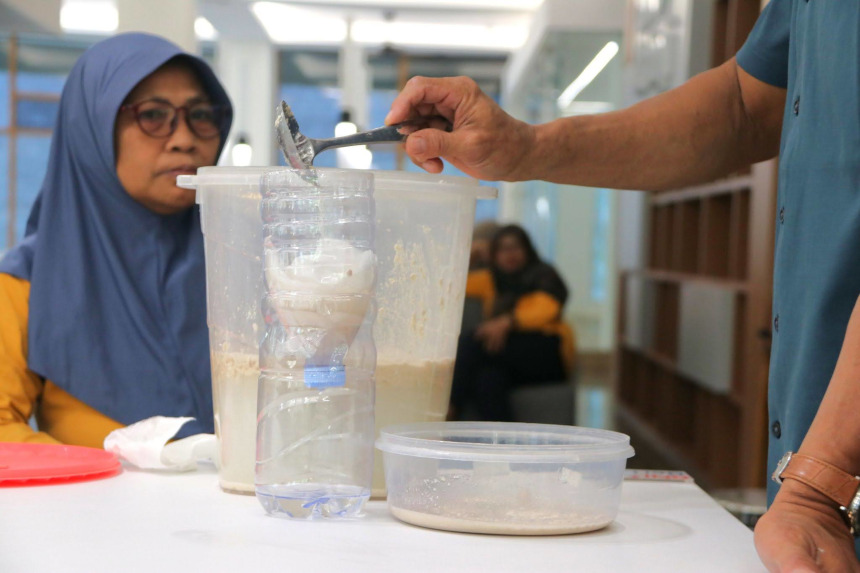 Sharing knowledge about VCO during the gathering gave participants the opportunity to learn how to make coconut oil independently while also contributing to greater health awareness and greater use of resources available in the surrounding environment.
The activity also supports Sustainable Development Goal (SDG) 3: Good Health and Well-being by encouraging greater attention to health and well-being. Lilik’s experience of consuming VCO was presented as a personal experience and served as a starting point for discussion about healthy lifestyle habits. At the same time, the process of sharing and learning together during the gathering supports SDG 4: Quality Education. Learning can take place in many ways, including through simple experiences and practical skills shared among employees.
From the coconuts found around their homes, participants took home more than just a recipe for making VCO. They gained experiences, practical skills, and knowledge that can be applied in their daily lives. The gathering demonstrated that learning can begin with something as simple as looking at what is available around us and discovering better ways to make use of it.
Contributor: Wasilatul Baroroh