
Kimpul, a local tuber that has recently gained widespread attention on social media, is more than just a substitute ingredient in creative cooking. Behind its newfound popularity, this local crop has been the subject of research at Universitas Gadjah Mada (UGM) for more than three decades. A search of the UGM Library and Archives’ Electronic Theses and Dissertations (ETD) collection has identified at least five studies on kimpul, covering a range of topics, from its functional properties and starch modification to microencapsulation and food packaging applications.
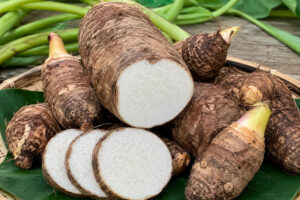 Kimpul’s recent popularity on social media was partly sparked by the unique content of a TikTok creator from Bantul, @black.sheep8208, widely known as Ibu Kimpul or Ibu Tin. In her videos, she often recreates trendy foods by replacing unavailable ingredients with kimpul. Her signature phrase, “Because I don’t have [the ingredient], so I’ll replace it with kimpul,” has become a defining feature of her content and has helped introduce kimpul to a wider audience.
The phenomenon is particularly interesting from an academic perspective. Long before kimpul became a topic of conversation on social media, UGM researchers had already been exploring the potential of this tuber, scientifically known as Xanthosoma sagittifolium.
The UGM ETD collection shows that research on kimpul dates back to 1992. One of the earliest studies is a master’s thesis by Judith Santje Clarfien Moningka, titled A Study of the Functional Properties of Flour and Starch from Mother and Daughter Kimpul Tubers (Xanthosoma sagittifolium Schott), in the Master’s Program in Food Science and Technology.
The study provided an early foundation for understanding kimpul not merely as a food ingredient, but also in terms of the properties of its flour and starch and their potential for various applications.
Research on kimpul subsequently expanded into more specific applications. In 2015, Warkoyo’s doctoral dissertation in Agricultural Engineering examined the Kinetics of Deterioration of Meatballs Coated with Active Edible Film Based on Kimpul Starch (Xanthosoma sagittifolium) During Storage. The study demonstrated that kimpul starch could be used as a base material for active edible films. One of the formulations tested extended the shelf life of meatballs to four days, compared with just one day for uncoated meatballs.
In 2017, Rosydina Ghassani compared maltodextrin derived from sweet potato, potato, kimpul, and taro starches as encapsulating agents for liquid smoke. The results showed that kimpul starch-derived maltodextrin had a solubility of 98.84 percent and a Dextrose Equivalent (DE) value of 10.15. Although potato starch-derived maltodextrin achieved the highest microencapsulation efficiency in the study, the findings nevertheless demonstrated the potential of kimpul starch for food applications.
The following study, conducted in 2018 by Khairunnisa Utama, examined the effect of steam explosion temperature on the characteristics of kimpul starch. The modification method was shown to alter the properties of the starch, including increasing its solubility while reducing its viscosity. These findings point to opportunities for using kimpul starch in food applications that require specific functional characteristics.
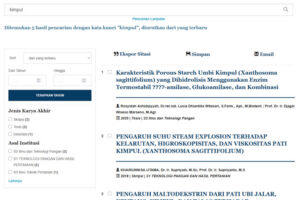 The most recent study in the UGM ETD collection was conducted in 2025. In her thesis, Characteristics of Porous Starch from Kimpul Tuber (Xanthosoma sagittifolium) Hydrolyzed Using Thermostable α-Amylase, Glucoamylase, and Their Combination, Rosyidah Ashidqiyyah investigated the potential of kimpul as porous starch—a modified starch with pores extending through the granules, resulting in a larger surface area and opening up possibilities for a wide range of applications.
Taken together, these studies demonstrate that kimpul has a long-standing presence in UGM’s research landscape. From studies of the basic properties of its starch in 1992 to its use in food packaging and encapsulation, and more recently the development of porous starch in 2025, kimpul has continued to attract academic interest as a local food resource with diverse potential applications.
The recent viral attention surrounding kimpul is a reminder that academic collections hold a wealth of knowledge relevant to issues currently being discussed by society. What may appear to be a social media trend can be explored further through documented research available in the UGM ETD collection.
Beyond simply following a trend, exploring research on kimpul highlights the importance of connecting local knowledge, academic research, and community needs. When a local food resource once again captures public attention, research conducted years earlier can provide an evidence-based foundation for exploring its potential applications more broadly.
This potential also aligns with the Sustainable Development Goals (SDGs), particularly SDG 2: Zero Hunger, by promoting the utilization of local food resources; SDG 9: Industry, Innovation and Infrastructure, through the development of food-processing technologies based on kimpul starch; and SDG 12: Responsible Consumption and Production, through the exploration of alternative food resources and the sustainable utilization of local resources.
Kimpul’s viral popularity may have started with a simple video and the phrase, “Because I don’t have [the ingredient], so I’ll replace it with kimpul.” Yet behind the humor lies a much longer history of knowledge and research. Kimpul had already found its place in UGM’s research laboratories long before it became a social media sensation. Now that it has once again captured public attention, perhaps it is time to see kimpul not merely as a trend, but as a local food resource whose potential is still waiting to be explored.
Contributor: Wasilatul Baroroh