
 The research is complete, the data have been collected, and the manuscript has been written. Yet, one question remains: what makes a manuscript worthy of publication in an international journal? The answer goes beyond the quality of the research findings. How researchers build a scientific narrative, present evidence, select a journal, and respond to reviewer comments all play a role in determining a manuscript’s journey toward publication.
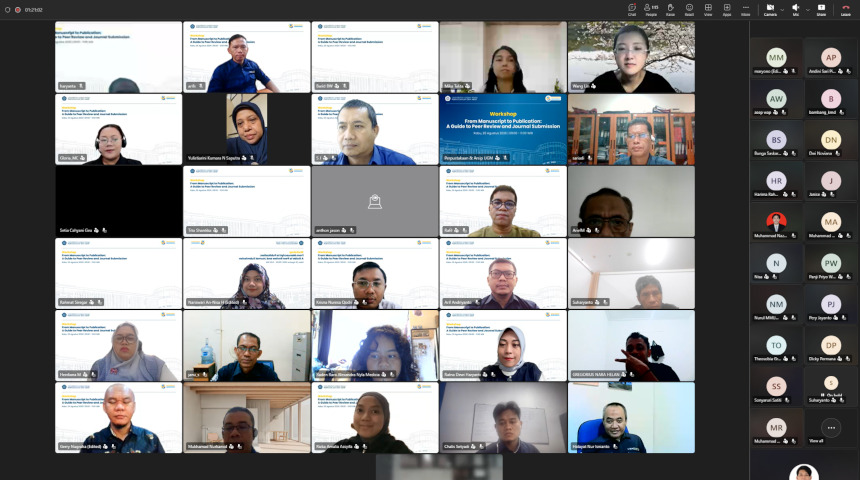
This was among the key insights shared by Dr. Lin Wang, Country Manager for China at AIP Publishing, during the workshop “From Manuscript to Publication: A Guide to Peer Review and Journal Submission,” organized by the UGM Library and Archives on Wednesday (August 26). The workshop equipped the university’s academic community with practical strategies for taking research from the manuscript stage through the international journal publication process.
Understanding the publication process is part of the UGM Library and Archives’ support for research activities. Head of the UGM Library and Archives, Arif Surachman, SIP., MBA., emphasized that the library has a responsibility to provide information and knowledge that can help members of the academic community produce high-quality publications.
“This is part of our responsibility at the library to provide information and knowledge about how publications are produced, in collaboration with the managers of journal databases subscribed to by Universitas Gadjah Mada,” Arif said.
According to Lin Wang, a good manuscript should have a clear scientific narrative. Authors need to explain why the research question is important, what problem the study seeks to address, what research gap it aims to fill, what methods were used, what findings were obtained, and how those findings contribute to the broader field of study.
“A good manuscript is a good story,” Lin Wang emphasized.
This story can be developed systematically using the IMRD (Introduction, Methods, Results, Discussion) framework. The structure helps authors ensure that the research problem, methods, results, and discussion are logically connected.
However, a good story still needs strong evidence. In academic writing, every claim should be supported by sufficient data. Lin Wang reminded researchers to use precise and specific language, avoid vague statements and exaggerated claims, and present data effectively—for example, through tables or graphs when complex information can be communicated more clearly through visual means.
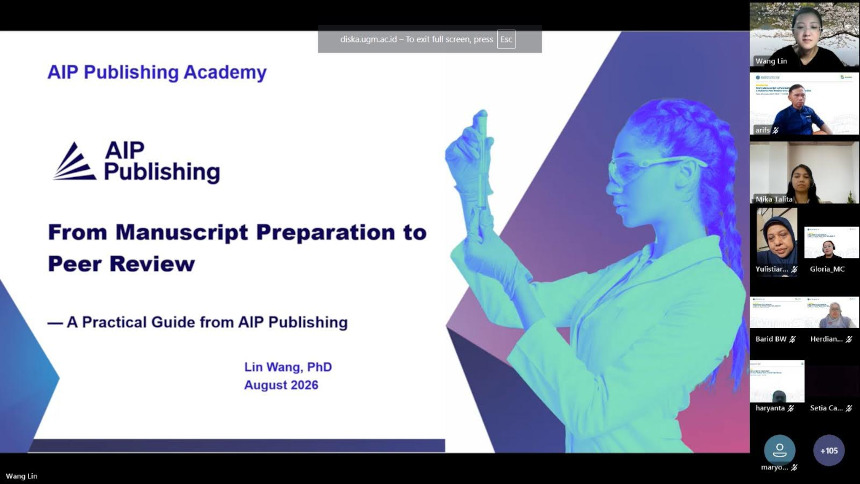 These principles reflect two key characteristics of effective academic writing emphasized by Lin Wang: brief and accurate. Being brief means focusing on important information and findings without burdening readers with unnecessary details. Being accurate means presenting facts precisely, providing clear citations, and ensuring that every statement is supported by evidence.
The same level of attention should be given to the title, keywords, and abstract. A title should be specific and accurately represent the research field, while keywords should be selected strategically to make the research easier to discover. One approach is to test potential keywords using publication search engines and identify terms that are most relevant to the research topic.
The abstract should also be strategically structured to communicate the essence of the research effectively. When submitting a manuscript, authors can also include a cover letter that briefly explains the study, its uniqueness, and its contribution.
“Need to communicate what becomes the novelty and why it’s worth it,” Lin Wang explained.
Once the manuscript is ready, the next question is where to submit it. Choosing a journal should not be based solely on its reputation. Authors need to examine the journal’s scope, manuscript requirements, and alignment with their research topic. Submitting a manuscript that falls outside a journal’s scope is one of the reasons a paper may be rejected.
If a manuscript passes the initial screening, it proceeds to the handling editor and external reviewers. Reviewers then evaluate the manuscript, which may result in acceptance, rejection, or a request for revision.
At the revision stage, authors need to understand the difference between minor revision and major revision. A minor revision may involve clarifying an argument or updating a figure, while a major revision may require additional analysis or new experiments.
Reviewer comments should also be addressed systematically. Lin Wang advised authors to provide a point-by-point response, clearly indicate the changes made, and provide data-based explanations when a particular reviewer suggestion cannot be implemented.
“Not all the revision needs to be revised accordingly. Just convince with data and explanation,” she said.
But what happens if a manuscript is rejected?
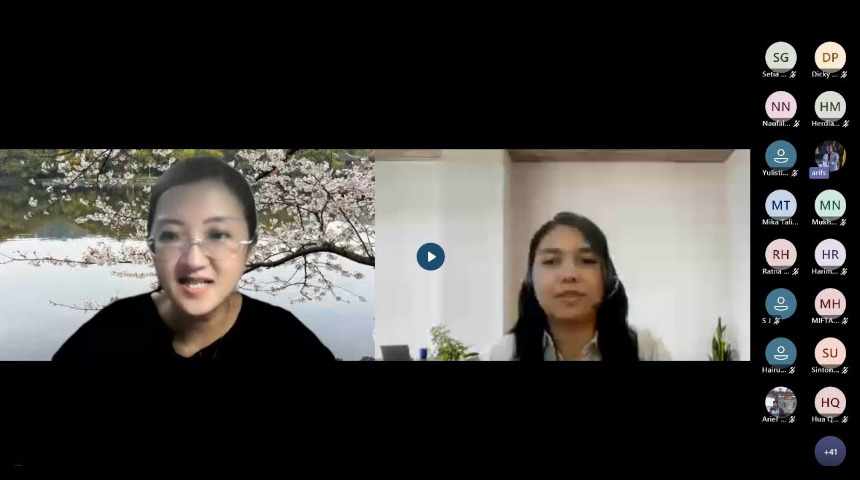 According to Lin Wang, rejection does not have to mark the end of the publication journey. Reviewer comments can be used to reassess and improve the manuscript. If the research is not a good fit for the journal, authors can consider submitting it to another journal that is more suitable. They may also seek collaborators working in a similar research area or submit an appeal if they have strong evidence and arguments to support their case.
“Consider transferring your manuscript to another journal, because maybe it’s more suitable there,” she advised.
Understanding the publication process broadens the role of the library in supporting research. Access to journals and scholarly databases needs to go hand in hand with the academic community’s ability to produce, evaluate, and communicate knowledge responsibly.
This effort aligns with SDG 4 (Quality Education) by strengthening academic capacity and research literacy; SDG 9 (Industry, Innovation and Infrastructure) by supporting research and knowledge-based innovation; and SDG 17 (Partnerships for the Goals) through collaboration with publishers and providers of scholarly information resources.
After all, academic publication is not simply about getting a study “published.” More importantly, every stage, from crafting a compelling research story to responding to reviewer feedback, is part of the process of ensuring that the knowledge produced is supported by strong evidence, offers a clear contribution, and reaches the right audience.
Contributor: Wasilatul Baroroh