
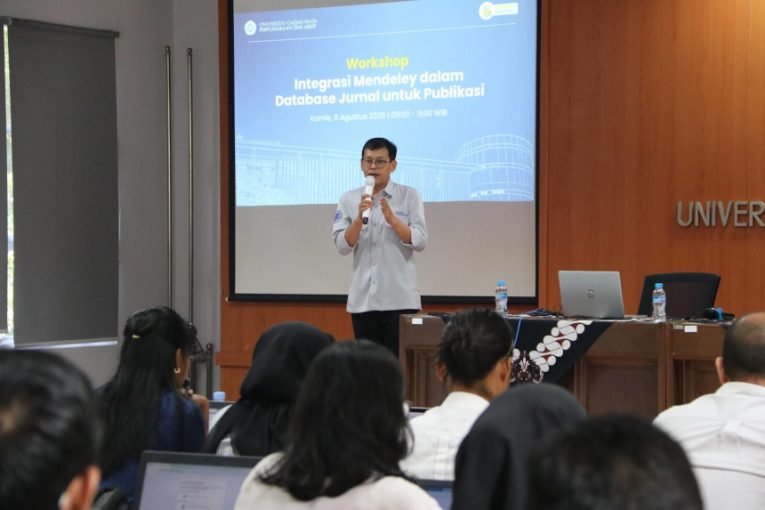
 The challenge of managing references and citations often becomes a stumbling block that slows down academics in writing scientific papers. For many researchers and students, compiling bibliographies and managing references is frequently the most time consuming and even frustrating phase of academic writing. A minor error in citation formatting can be fatal during the journal review process. Addressing this academic concern, the Universitas Gadjah Mada (UGM) Library and Archives took a proactive step by organizing the “Academic Writing Serial Literacy Workshop: Mendeley Integration in Journal Databases for Publication.”
Held on Thursday (August 6, 2026), from 09:00 to 11:00 WIB, the event combined face-to-face sessions in the Seminar Room on the 2nd Floor of Building L1 at the UGM Library and Archives with online participation, accommodating attendees from various locations. The flexibility of this hybrid format successfully attracted dozens of enthusiastic academics, breaking down physical spatial barriers to ensure equitable literacy access for all library users.
The event was officially opened with warm welcoming remarks from Erna Widayati, Head of the Archives Division at the UGM Library and Archives. Representing the institution’s leadership, Erna extended her appreciation and welcome to all participants attending both offline and online. She also expressed her prayers and high hopes that this literacy agenda would run smoothly and yield a positive impact on the university’s research progress. “We hope that the knowledge shared in this workshop will truly provide tangible benefits and serve as a practical solution that can be directly implemented in your scientific writing and publication processes,” she stated.
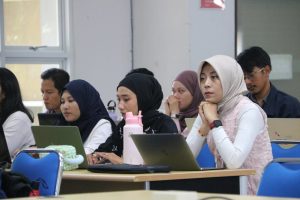 Moderated by Dewi Nurhastuti, the workshop featured Maniso Mustar, a UGM Librarian and Chairman of the UGM Librarian Forum. Participants were guided to delve into effective reference management techniques, ranging from automatically importing article metadata and organizing personal digital libraries to optimizing citation plugin features that ensure the writing format aligns seamlessly with international journal standards.
“Reference management is not merely about tidying up a bibliography at the end of the writing process; it is about maintaining academic integrity and optimizing the researcher’s time efficiency. Through the optimization and integration of tools like Mendeley, we at the UGM Library are committed to ensuring that every scientific work born from this campus rests on a solid, structured, and accountable literature foundation,” Maniso emphasized in his presentation.
The presence of this serial literacy program represents a transformation in the role of the UGM Library and Archives. The library no longer stands passively as a book repository space but has evolved into an active research partner, accompanying the academic community from the literature search phase and research data governance to pre-publication technical support.
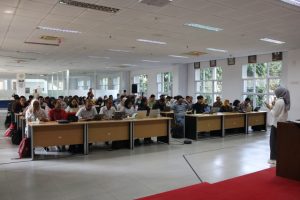 This ongoing commitment by the UGM Library is a tangible step toward supporting the achievement of the Sustainable Development Goals (SDGs). Specifically, this activity contributes to SDG 4: Quality Education by enhancing information literacy and academic capacity, and to SDG 9: Industry, Innovation, and Infrastructure by accelerating research and innovation through the efficient use of information technology.
For academics who were unable to attend or wish to participate in the next literacy series, the UGM Library and Archives continuously updates program registration information via its Instagram account @perpustakaan_ugm and other official UGM Library and Archives information channels.
In this era of information disruption, the quality of a scientist is measured not only by how brilliant their ideas are but also by how neatly they can map the literary footprints of their predecessors. The question remains: is your reference management ready to help your scientific work compete on the global stage?
Contributor: Kristi Putri Nabila