
Amid the demands of competitive research globalization, the use of artificial intelligence (AI) is increasingly opening up opportunities for the academic community to explore literature, understand research findings, and improve the effectiveness of scientific writing. To address this need, the University of Gadjah Mada (UGM) Library and Archives held a workshop titled “Harnessing AI Technologies for Writing International Publications Indexed in EBSCO” on Tuesday (October 27) at the Computer Lab, 5th Floor, L1 Building, UGM Library and Archives.
 The event began with opening remarks from the Head of the UGM Library and Archives, Arif Surachman, SIP., MBA. In his address, Arif emphasized the importance of mastering technology-based research tools for academics and researchers on campus.
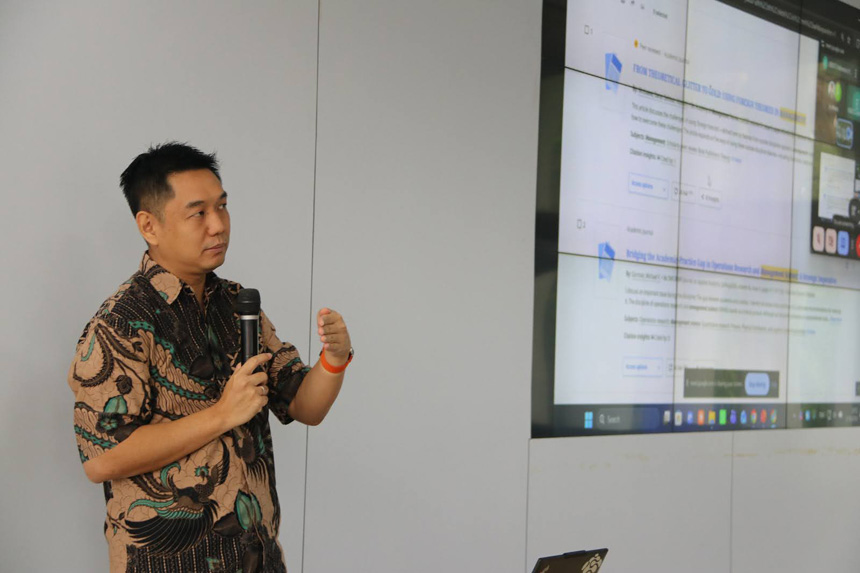
The main session was moderated by Barid Budi Wicaksono, M.A., a librarian at UGM. This was followed by a presentation by Erik Junikon, Regional Sales Manager at EBSCO (Brunei, Indonesia, and Timor-Leste).
One of the main topics discussed was the AI Insight and AI-Assisted Search features. Currently, EBSCO is introducing a number of AI-based features that are still in the beta testing phase, such as AI-Assisted Search (conversational search) and AI Insight, to help users quickly understand article summaries along with a clear list of references.
During the presentation, the speaker emphasized the importance of critical thinking when using this advanced technology so that users do not simply accept AI-generated output at face value. “Even though this is generated by AI, users still need to analyze it, right? So, you have to think critically and analyze the information to determine whether the points presented align with the article. In other words, we shouldn’t just accept it 100 percent and copy-paste it,” he reminded the participants.
In addition to AI technology, the presenter explained the multidisciplinary scope of the EBSCO database, which makes it useful for researchers across various academic disciplines. Participants were also introduced to features that help identify a journal’s indexing status in Scopus and Web of Science, as well as the “Cited By” feature for finding articles that cite a particular publication.
The discussion also covers the use of Advanced Search, Boolean operators such as AND, OR, and NOT, the use of quotation marks to search for specific phrases, and the asterisk symbol to find variations of a word. To support reference management, EBSCO offers the option to copy citations in specific formats, export references to applications such as Mendeley and EndNote, and save articles via supported cloud services.
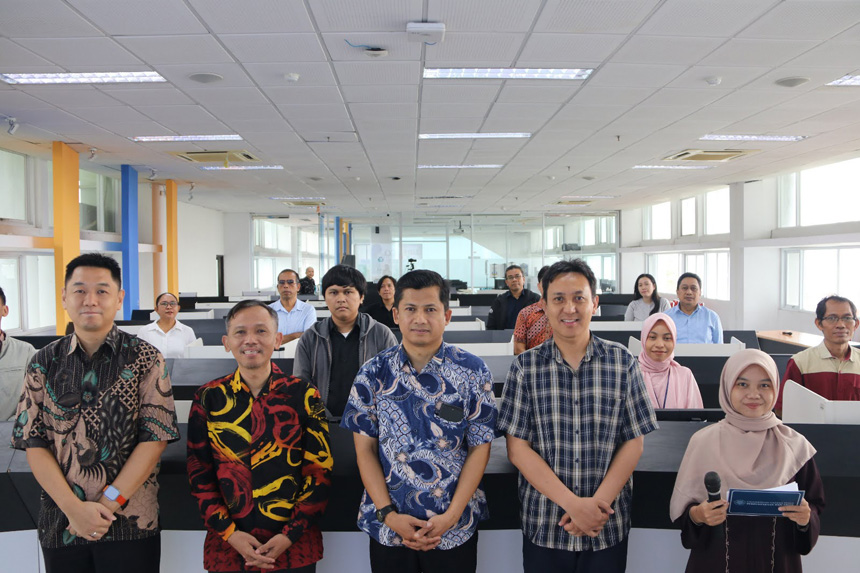 This workshop aligns with Sustainable Development Goal (SDG) 4: Quality Education, particularly by strengthening access to learning resources and enhancing academic capacity. This initiative also supports SDG 9: Industry, Innovation, and Infrastructure, by introducing the use of digital technology and AI to support research activities, as well as SDG 17: Partnerships for the Goals, through knowledge exchange between universities and scientific information service providers.
This initiative is part of an effort to support the academic community in becoming more skilled at responsibly utilizing scientific information sources and digital technology. The advent of AI opens up opportunities to accelerate the process of literature search and comprehension, but the quality of publications still depends on the accuracy of methods, the validity of sources, the originality of ideas, and the authors’ responsibility to verify all information used.
Ultimately, technological progress is not merely about how quickly researchers find information, but also about how that information is processed into accountable knowledge that benefits society.
Contributor: Athaya Nasywa Shabrina