
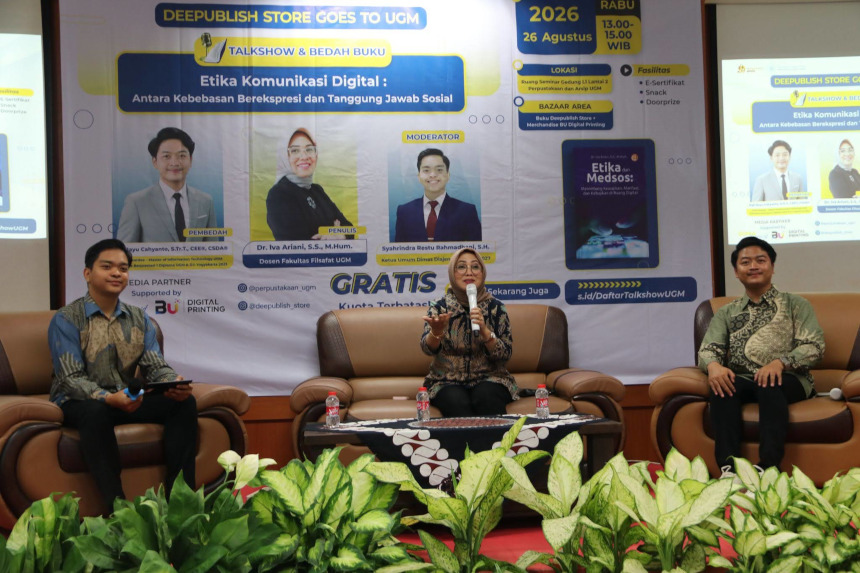
Social media has become an integral part of everyday life, serving not only as a means of communication and information access but also as a space for building relationships, developing personal branding, and supporting educational and professional activities. This situation makes an understanding of ethics and responsibility in using social media increasingly important. This issue was the focus of the Talkshow and Book Discussion themed “Ethics of Using Social Media in the Digital Era,” held as part of the “Deepublish Store Goes to UGM” series. The event was organized by the Library and Archives of Universitas Gadjah Mada (UGM) in collaboration with Deepublish Store on Wednesday (26/8) as an in-person event.
Head of the UGM Library and Archives, Arif Surrachman, stated that the book discussion was a form of collaboration between the UGM Library and Archives and its partner, Deepublish, to support the UGM academic community, particularly in encouraging academic publication activities. According to him, the collaboration reflects the Library and Archives’ commitment to continuously supporting the academic community in developing and publishing scholarly works.
In his remarks, Arif also highlighted the importance of the theme “Digital Communication Ethics: Between Freedom of Expression and Social Responsibility.” He considered the issue highly relevant to society, particularly younger generations who are increasingly active on social media. According to Arif, the ease of sharing information through social media needs to be accompanied by caution and responsibility, as content that has already been shared can quickly go viral and become difficult to retract.
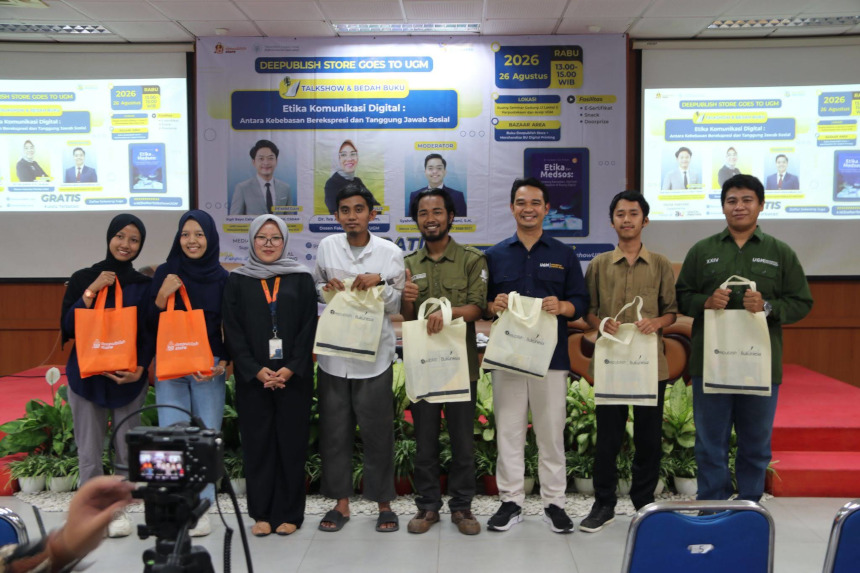 Therefore, the event served as one of the efforts of the UGM Library and Archives to raise awareness among the academic community about using digital media wisely, responsibly, and ethically. The UGM Library and Archives remains committed to supporting the academic community in critically navigating developments in digital communication and understanding the impact of information shared in digital spaces.
Lukman, S.T., Manager of Deepublish Store, also delivered remarks at the event. In his speech, Lukman shared his experience with social media, which at one point made him feel “controlled” by it and led him to uninstall his social media accounts in 2018. After redirecting his time toward more productive activities, such as managing sales through an online marketplace, he eventually returned to social media, not merely for browsing, but as a means of supporting his productivity and business activities. He emphasized the importance of changing the way social media is used so that users are not controlled by technology, but are instead able to utilize it wisely for productive purposes. Through the talkshow and book discussion, he hoped participants would gain new insights and become more responsible in using social media.
Moderated by Syahrindra Restu Ramadhani, S.H., Chairperson of Dimas Diajeng DIY 2025–2027, the event featured Dr. Iva Ariani, S.S., M.Hum., a lecturer at the Faculty of Philosophy UGM and author of Etika dan Medsos: Menimbang Kewajiban, Manfaat, dan Kebajikan di Ruang Digital (Ethics and Social Media: Considering Duties, Benefits, and Virtues in the Digital Space), and Sigit Bayu Cahyanto, S.Tr.T., CEE®, CSDA®, LPDP Awardee – Master of Information Technology and UGM Outstanding Student, as speakers.
In her presentation, Iva Ariani explained that social media can no longer be viewed merely as a technological tool, but has become part of a new space of everyday life. According to Iva, various activities, ranging from seeking information and building relationships to finding employment and generating income, are now increasingly conducted through social media. This situation requires people to reconsider how they use social media and recognize that every activity carried out in digital spaces can have consequences in real life.
Iva emphasized that ethics should not be understood as a means of restricting freedom of expression, but rather as a way to ensure that such freedom is accompanied by responsibility. According to her, digital spaces have a much wider reach than interactions in everyday life, meaning that a single post can be viewed by a large number of people and potentially affect an individual well into the future. She also reminded social media users to be more selective when responding to viral information, as not everything that attracts public attention is necessarily beneficial to share. “We should no longer focus only on how to post something good and useful, but on how to be a good human being in this digital space,” Iva explained.
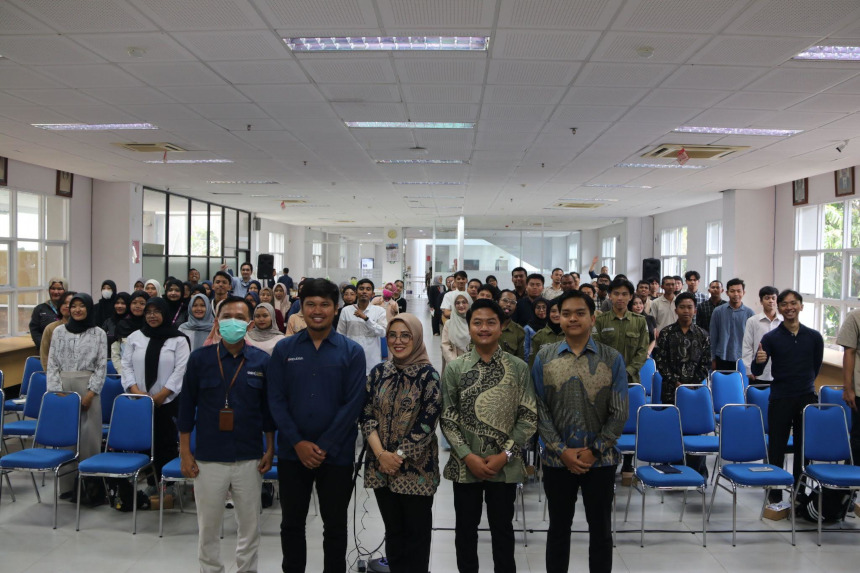 Meanwhile, Sigit Bayu viewed social media as a space that provides freedom of expression while simultaneously requiring users to take responsibility for their actions. He explained that social media can serve as a platform for building personal branding, expanding networks, accessing educational and employment opportunities, and showcasing an individual’s activities and character. According to Sigit, the character displayed on social media essentially overlaps with one’s character in real life. Therefore, users need to be mindful of every post, comment, and other digital activity they engage in.
Sigit also emphasized the importance of checking the credibility of information before sharing or commenting on an issue, particularly when the issue is going viral. Users need to understand the context, consider potential consequences, and observe ethical principles to avoid offending others, damaging someone’s reputation, or manipulating public opinion. He also highlighted the importance of understanding how social media algorithms work, as the content users frequently search for, view, and post can influence the content that subsequently appears on their timelines. “We need to take responsibility for what we upload on social media and consider its essence—whether it is beneficial or not,” Sigit stated.
Furthermore, Iva explained that algorithms can create an information environment in which users continuously receive content that aligns with their existing views and habits. This condition may place users within an information bubble that continuously reinforces their own perspectives. Therefore, the ability to think critically and understand context is essential to prevent users from being easily carried away by information trends or viral phenomena on social media.
Through the discussion, both speakers emphasized that responsible social media use is not merely about the ability to create or share content, but also about developing character and embracing responsibility as digital citizens. Social media can be utilized for various productive purposes; however, freedom of expression must always be balanced with awareness of its consequences, ethical considerations, and social responsibility.
This initiative aligns with Sustainable Development Goal (SDG) 4: Quality Education, particularly by enhancing the academic community’s digital literacy and understanding of ethics and responsibility in digital communication. The event also supports SDG 9: Industry, Innovation and Infrastructure, particularly by encouraging the wise, productive, and responsible use of technology and digital media. In addition, the event contributes to SDG 17: Partnerships for the Goals through collaboration between the UGM Library and Archives and its partners in creating educational and discussion spaces addressing the challenges of communication in the digital era.
As awareness among the academic community of ethical social media use increases, so does the potential to create a healthier, more critical, and more responsible digital environment. For the UGM Library and Archives, organizing educational activities on digital literacy and ethics is part of its efforts to support the academic community not only in utilizing technology effectively, but also in developing awareness of the impact of every piece of information and interaction carried out in digital spaces.
Contributor: Gloria Ayuningtyas