
“Have a great research idea but still unsure where to find the right references?” This challenge continues to be faced by many students and researchers. To address this need, UGM Library and Archives organized the “From Exploration to Publication with Cambridge University Press (CUP)” workshop on Wednesday (July 8), inviting hundreds of participants to learn how to discover high-quality scholarly literature and understand the publication process with one of the world’s most prestigious academic publishers.
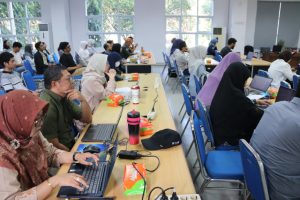
Held both onsite at the Seminar Room, 2nd Floor of UGM Library and Archives, and online, the workshop attracted hundreds of participants, including students, lecturers, and administrative staff from Universitas Gadjah Mada. The session featured Jona Giovani Harahap, Account Manager of Cambridge University Press Indonesia, and was nicely moderated by Afni Isnaini Aprilia, S.IP., from the Faculty of Law, UGM.
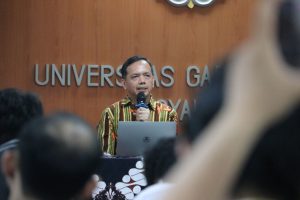
 Opening the event, Wahyu Supriyanto, S.E., M.Si., Head of the Library Division at UGM Library and Archives, emphasized that the ability to locate and evaluate scholarly information has become an essential skill for every researcher.
“Today, we must have the ability to filter and make effective use of scholarly databases for academic writing,” he said.
According to Wahyu, the overwhelming amount of information available on the internet makes the ability to identify reliable references more important than ever. Scholarly databases enable researchers to access trustworthy sources, ultimately improving the quality of their research.
During the workshop, participants explored a wide range of features offered by Cambridge University Press. The session covered how to search for relevant journal articles and e-books, use advanced search filters to refine search results, and understand the publication process for submitting manuscripts to Cambridge University Press.
Jona explained that Cambridge University Press is one of the world’s oldest academic publishers, with a reputation built over centuries.
“Cambridge is one of the world’s oldest academic publishers, dating back to the sixteenth century. Its quality and credibility have therefore stood the test of time,” he explained.
He also shared practical strategies for conducting more effective literature searches, including selecting appropriate keywords and utilizing advanced search features that many users have yet to explore. In addition, participants were introduced to the publication process at Cambridge University Press, from selecting the most suitable journal to strategies for increasing the likelihood of manuscript acceptance in reputable international journals.
Participants remained highly engaged throughout the session, taking the opportunity to discuss effective approaches to finding literature relevant to their research topics and exploring publication opportunities in international journals.
 Through this workshop, UGM Library and Archives reaffirmed its role as more than a provider of information resources. It serves as a learning and research partner for the UGM academic community by offering training programs that strengthen information literacy and foster a strong research culture across the university.
This initiative contributes to the achievement of Sustainable Development Goal (SDG) 4: Quality Education by enhancing information literacy competencies and expanding access to high-quality scholarly resources, SDG 9: Industry, Innovation and Infrastructure by strengthening the research and innovation ecosystem through scientific publications, and SDG 17: Partnerships for the Goals through the strategic collaboration between UGM Library and Archives and Cambridge University Press in expanding access to scholarly resources and enhancing publication capacity for the academic community.
As global competition in scholarly publishing continues to intensify, the ability to identify relevant literature, utilize reputable academic databases, and build partnerships with international institutions has become increasingly important for producing impactful, high-quality research. Through collaborations such as this, UGM Library and Archives remains committed to supporting the academic community from the initial stage of literature exploration to the successful publication of their research.
Contributor: Wasilatul Baroroh