
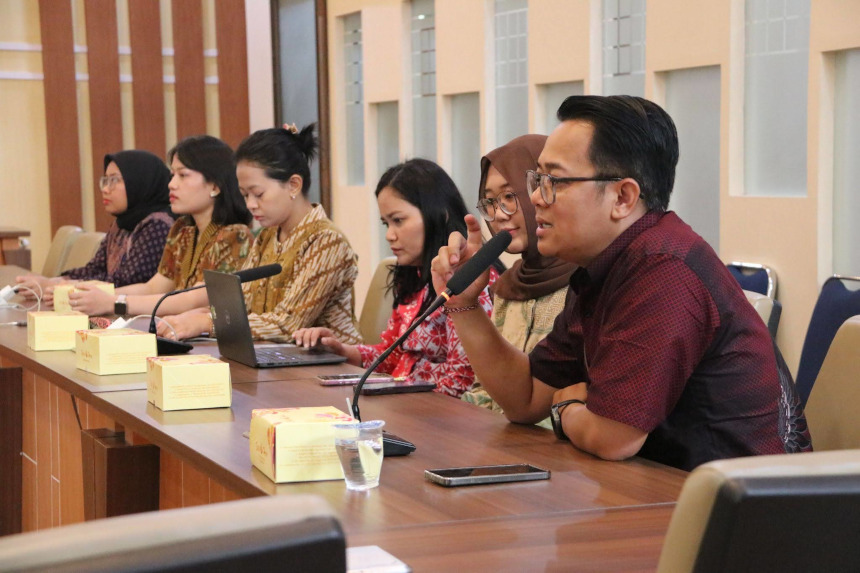
 The history of Indonesia’s development planning is preserved not only in official documents. Traces of ideas, decisions, and institutional developments can also be found in archives, books, and scholarly works that capture the dynamics of their respective periods. These traces are now being revisited by the Ministry of National Development Planning/National Development Planning Agency (Bappenas) through the collections of the Universitas Gadjah Mada (UGM) Library and Archives.
The team responsible for compiling the History Book of the Deputyship for Macroeconomic Development Planning at Bappenas visited the UGM Library and Archives on Friday (4 September) to explore various sources that could enrich the documentation of institutional history and the development of national planning. The search covered archival materials, books, and Electronic Theses and Dissertations (ETD) held by UGM. These diverse sources provide important perspectives for revisiting the historical journey from multiple angles.
Eka Chandra Buana, Deputy for Macroeconomic Development Planning at Bappenas, said the research aimed to identify historical sources to enrich the documentation of institutional history, particularly the development of the Deputyship for Macroeconomic Development Planning.
The search at UGM is part of Bappenas’ efforts to complement the historical sources the team has previously gathered. Archives, books, and scholarly works are being examined to uncover traces that can help illuminate institutional developments and the evolution of ideas in development planning over time. In this process, the collections of the UGM Library and Archives serve as valuable sources that enrich the information already gathered by the team.
Head of the UGM Library and Archives, Arif Surachman, SIP., MBA., welcomed the research visit. He explained that access to archival materials is subject to specific provisions to ensure that their use complies with applicable archival regulations.
“Accessing archives is subject to certain regulations. In general, archival materials can be accessed through the applicable service procedures,” said Arif.
Head of the Archives Division of the UGM Library and Archives, Erna Widayati, S.E., M.M., explained that archival research can be conducted through the archival services room. Access to certain archival materials is also subject to applicable regulations and service fees, which include provisions related to archival preservation and management.
During the archival search, the Bappenas team was accompanied by UGM archivist Kurniatun, SIP. The assistance was provided to help identify and locate archival materials relevant to the research.
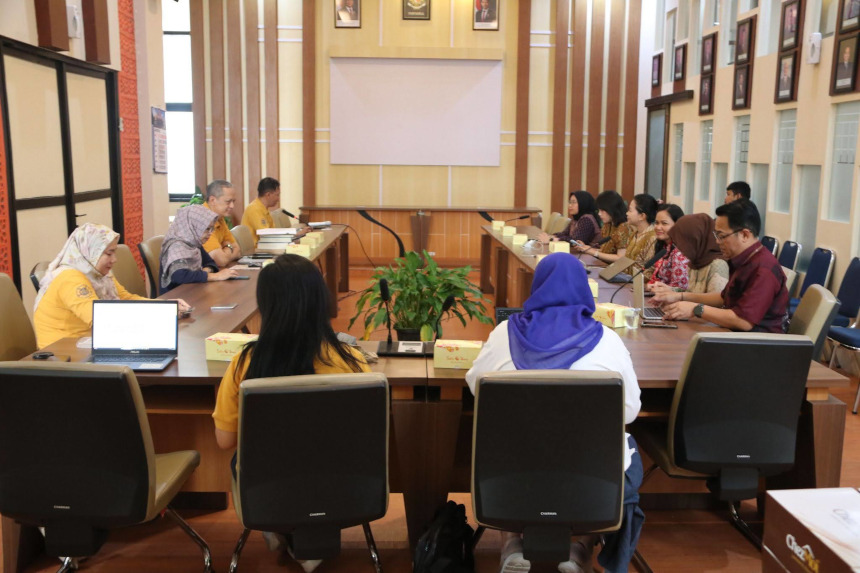 From the archives room, the search then extended to the library collections. Head of the Library Division, Wahyu Supriyanto, S.E., M.Si., said that several books sought by the Bappenas team were available in the collections of the UGM Library and Archives. The team also explored the ETD collection, which contains scholarly works produced by members of the UGM academic community.
To facilitate the search, Yulistiarini Kumaraningrum, S.E., M.M., explained that the availability of books and ETD materials can first be checked through the library catalogue. Access to ETD materials is provided through the ETD Room in accordance with applicable regulations.
The search also led the Bappenas team to collections of particular historical significance. Safirotu Khoir, Ph.D., Coordinator for Public Relations and International Affairs at the UGM Library and Archives, introduced the Lawang Sajarah rare collection, which was formerly part of the Hatta Foundation Library.
The collection is associated with Mohammad Hatta, a prominent Indonesian figure known for his strong interest in economic and development issues. Some of the books in the collection are original works by Hatta and may provide relevant intellectual context for research into the history of development planning.
The use of archives, books, ETD materials, and rare collections as research sources contributes to Sustainable Development Goal (SDG) 4: Quality Education by providing knowledge resources that support learning and research. Efforts to preserve and provide access to institutional records also contribute to SDG 16: Peace, Justice and Strong Institutions, as archives play an important role in preserving institutional memory and documenting an organization’s development. Meanwhile, collaboration between Bappenas and UGM in tracing, verifying, and utilizing historical sources supports SDG 17: Partnerships for the Goals through inter-institutional cooperation to produce a more comprehensive historical record.
From archival documents to books preserved for decades, every collection holds a fragment of a story. Tracing these records brings stored knowledge back to life and opens new perspectives for understanding how Indonesia’s development ideas and policies have evolved over time.
Contributor: Wasilatul Baroroh