
AI can accelerate research. But can we trust it completely? This crucial question has emerged amid the growing use of artificial intelligence in academia, where AI has increasingly become a double-edged sword for the credibility of scientific work.
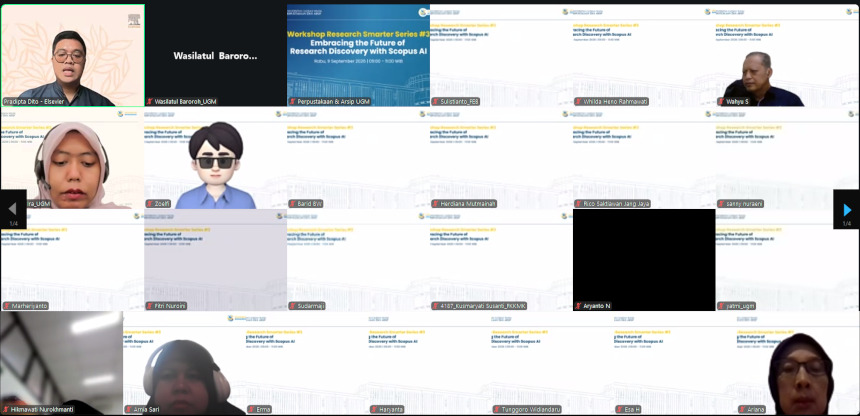 In response to this challenge, the Library and Archives of Universitas Gadjah Mada (UGM) held the Research Smarter Series Workshop #3, titled “Embracing the Future of Research Discovery with Scopus AI,” online on Wednesday (September 9). The event aimed to equip UGM faculty members, researchers, and students with the knowledge and skills to navigate Generative AI ethically and responsibly.
The initiative also reflects the Library and Archives of UGM’s commitment to supporting the pillars of the Sustainable Development Goals (SDGs). It directly contributes to SDG 4 (Quality Education) by strengthening digital literacy and academic integrity; SDG 9 (Industry, Innovation and Infrastructure) by reinforcing a research ecosystem built on trusted technology; SDG 16 (Peace, Justice and Strong Institutions) by promoting transparency and accountability in academia and addressing threats such as academic misconduct, data fabrication, and fabricated citations; and SDG 17 (Partnerships for the Goals) through strategic collaboration between UGM as an educational institution and global scholarly information provider Elsevier to advance the quality of research in Indonesia.
Head of the Library Division at the Library and Archives of UGM, Wahyu Supriyanto, S.E., M.Si., emphasized the importance of academics embracing technological advances without compromising ethical standards.
“Technology is becoming increasingly sophisticated, making it essential for researchers to use artificial intelligence (AI) wisely to support the research process,” Wahyu said in his opening remarks.
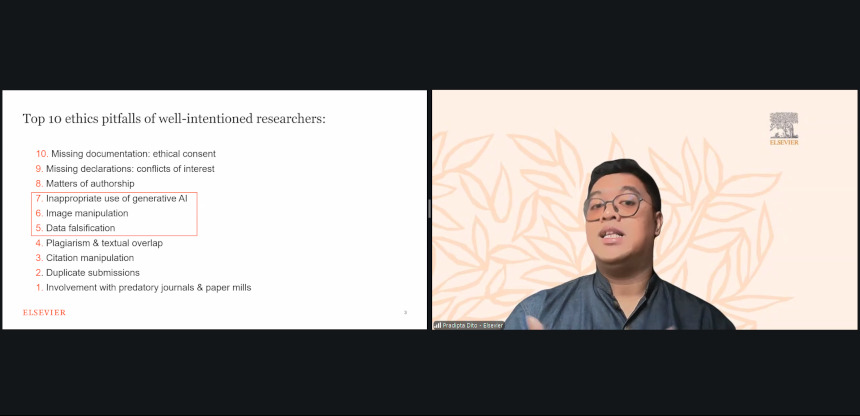 During the main session, Pradipta Faikar Hakim, Customer Success Manager, Elsevier Southeast Asia – Indonesia, highlighted the surprising risks associated with using public, consumer-grade AI tools to produce scholarly work. Research data show that although 58% of researchers have used AI, only 22% fully trust its output. This concern stems from the risk that public AI tools may generate up to 19.9% fabricated citations and more than 45% citation errors.
Pradipta also addressed a common misconception regarding the role of AI in scholarly publishing. In accordance with Elsevier’s policies and global academic integrity standards, AI cannot be credited as a co-author.
“AI does not replace the role of authors. Instead, it serves as a support tool for synthesizing literature, generating ideas, or improving grammar. Authorship carries moral and legal responsibility, which can only be assumed by humans,” Pradipta emphasized.
To address the risks of fabricated citations and information overload, Elsevier introduced Scopus AI. Unlike general-purpose AI tools, the platform operates exclusively using Scopus’s curated database, supported by stringent data security systems. Advanced features such as Summary & Expanded Summary, complete with a confidence level, Concept Map, Foundational Documents, and Topic Experts are designed to accelerate research mapping without compromising accuracy.
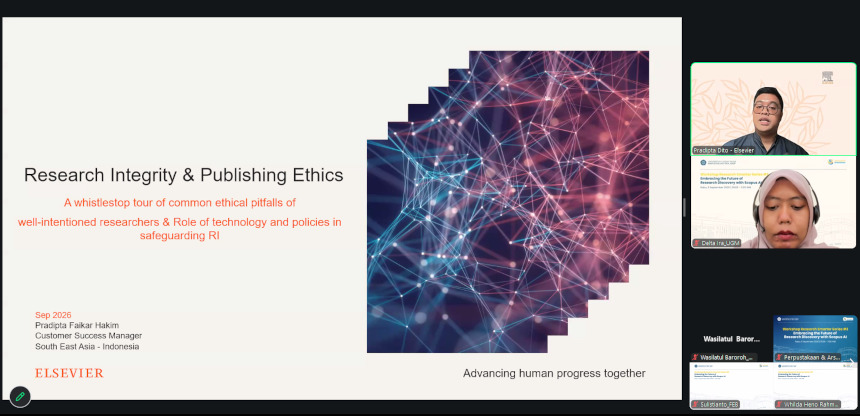 Nevertheless, even the most sophisticated technology still requires human oversight.
“Researchers must evaluate whether the articles identified by Scopus AI are genuinely relevant to their research topic. After all, researchers themselves understand the context and direction of their research best,” Pradipta concluded.
The emergence of AI has permanently transformed the way the world discovers knowledge. For academics, the greatest challenge is no longer how quickly technology can deliver information, but how wisely researchers can uphold honesty and integrity in every piece of work they produce.
Contributor: Wasilatul Baroroh