
The information needs of the academic community continue to be an important consideration in the collection development of Universitas Gadjah Mada (UGM) Library and Archives. To ensure that its collections remain aligned with these needs, UGM Library and Archives is reviewing its 2026 Collection Development Policy.
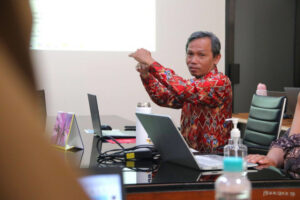
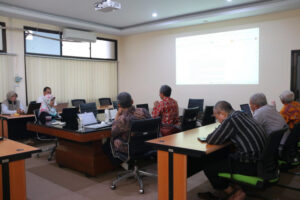
The review was conducted through a meeting to align the draft Collection Development Policy on Tuesday (August 11) at the L6 Meeting Room, 2nd Floor, UGM Library and Archives. The meeting discussed nine proposed revisions to be incorporated into the policy draft, which had been adjusted to comply with UGM’s official document formatting standards.
The meeting began with introductory remarks from Yulistiarini Kumaraningrum, S.P., M.M., Head of Data and Information Systems. The discussion was then continued by Aprilia Mardiastuti, S.I.P., M.A., Coordinator of Collection Development, who presented an update on the policy drafting process.
As part of the drafting process, several technical matters will be addressed through separate work instructions. According to Aprilia, this approach is intended to ensure that the policy provisions provide clear direction for collection development, while more detailed technical requirements can serve as practical guidelines for implementation.
“Technical activities will be addressed separately through work instructions so that the provisions of the Collection Development Policy can be optimized,” said Aprilia.
 Several technical guidelines have also been prepared as supporting documents for the policy. Two of the current priorities are guidelines for selecting collections received through gifts, grants, and donations, as well as guidelines for the collection development quadrant.
The preparation of these technical guidelines also takes into account the components required for library accreditation. Roh Wahyu Widayati, S.I.Pust., explained that there are six elements of collection management that need to be fulfilled. Since these elements involve detailed technical aspects, they need to be set out in separate documents.
“According to the library accreditation components, there are six elements of collection management that need to be fulfilled and cannot be included in the Collection Development Policy. Therefore, separate provisions or technical guidelines have been prepared,” explained Roh Wahyu.
Head of UGM Library and Archives, Arif Surachman, S.I.P., M.B.A., expressed his appreciation for the team’s efforts in drafting and aligning the policy. He emphasized that collection development plays an important role in ensuring that the information needs of library users are properly addressed.
“This is one of the areas that needs to be expedited, because collection development is important in determining what library users need,” said Arif.
He also emphasized the importance of evaluating the policy after it is established. Changes in users’ information needs and the academic environment should be taken into consideration when reviewing the policy.
“The policy being proposed must still be evaluated every year to determine whether it remains relevant to current conditions,” he said.
 Following the meeting, the appointed team will continue the process of aligning the draft 2026 Collection Development Policy. The nine proposed revisions will be integrated and aligned with the overall policy framework before proceeding to the next stage.
This initiative supports Sustainable Development Goal (SDG) 4: Quality Education by strengthening information resources that support learning and research. A well-directed collection development process also contributes to SDG 9: Industry, Innovation and Infrastructure, particularly by strengthening knowledge infrastructure within the academic environment.
The Collection Development Policy serves as an important foundation for ensuring that the library’s collections remain relevant to users’ needs. Regular evaluation and refinement are expected to ensure that collection development decisions remain well-directed and continue to provide value to the academic community.
Contributor: Wasilatul Baroroh