
The development of artificial intelligence (AI) presents new challenges for academia, particularly in maintaining the originality and integrity of scholarly works. In response to these challenges, the Library and Archives of Universitas Gadjah Mada (UGM) held a Turnitin Optimization Workshop for Turnitin administrators and instructors across UGM on Thursday, November 19.
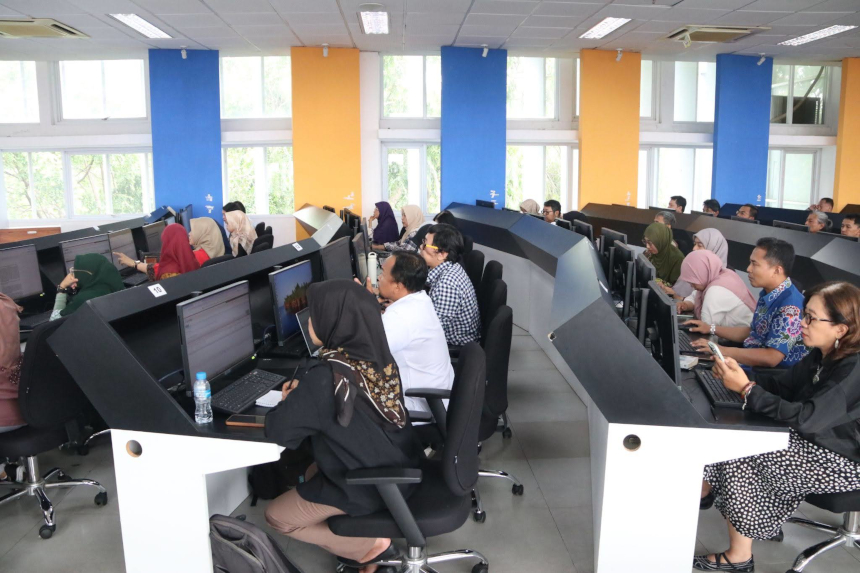 Held at the Computer Laboratory, 5th Floor, Building L1, UGM Library and Archives, the workshop aimed to optimize the use of Turnitin Feedback Studio and to provide administrators and instructors with an opportunity to share technical difficulties and experiences encountered while using the service. Through this workshop, participants were expected to gain a better understanding of the available features and maximize their use in supporting academic quality assurance.
In his opening remarks, Head of UGM Library and Archives, Arif Surachman, SIP., MBA., stated that the workshop provided an opportunity for instructors to gain a deeper understanding of how to use Turnitin Feedback Studio. He also emphasized the importance of direct interaction with the speaker, allowing participants to raise the challenges they had encountered and seek practical solutions.
“We hope this workshop will help optimize the use of Turnitin Feedback Studio. We also want to provide participants with an opportunity to directly discuss the challenges they have encountered with the speaker,” he said.
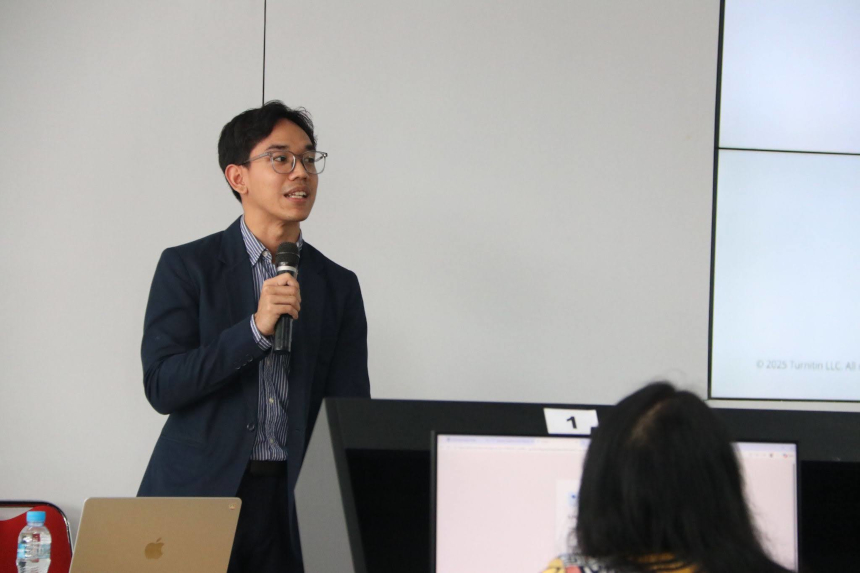 The workshop was led by Yalqa M. Dzimar, Account Manager at Turnitin Indonesia. During the presentation, Yalqa explained various features of Turnitin Feedback Studio and how they can be used in examining similarities in academic manuscripts.
One of the features highlighted during the session was Review All Matching Sources. This feature allows users to review multiple sources that match the document being examined. However, reviewing a similarity report involves more than simply looking at the similarity percentage. Users need to apply critical thinking skills to identify the context of similarities, assess the relevance of sources, and determine whether the identified similarities indicate potential issues in academic writing.
The discussion also covered developments in Turnitin’s AI Writing Detection feature amid the growing use of AI in academic writing. Yalqa explained that the feature’s margin of error is below one percent. Meanwhile, efforts to develop AI writing detection capabilities for Indonesian-language texts are ongoing, with implementation targeted for 2027.
Following the presentation, the workshop continued with a hands-on session on using Turnitin Feedback Studio. Participants had the opportunity to explore its features and consult the speaker about various challenges they encountered in their roles as instructors and when reviewing academic documents. The high level of engagement was evident in the numerous questions participants raised, seeking clarification and practical solutions to their ongoing challenges.
The workshop reflects UGM Library and Archives’ commitment to fostering an academic environment grounded in honesty, responsibility, and scholarly ethics. This initiative aligns with Sustainable Development Goal (SDG) 4: Quality Education by strengthening human resource capacity and improving educational quality, as well as SDG 17: Partnerships for the Goals, through collaboration between the UGM Library and Archives and Turnitin Indonesia to enhance the use of technology to support academic integrity.
Through the optimized use of Turnitin, administrators and instructors are expected to become better equipped to support the examination of scholarly works. After all, maintaining academic integrity is not merely about detecting similarities or AI-generated content; it is also about fostering a scholarly culture that values honesty, critical thinking, and respect for intellectual work.
Contributor: Wasilatul Baroroh