
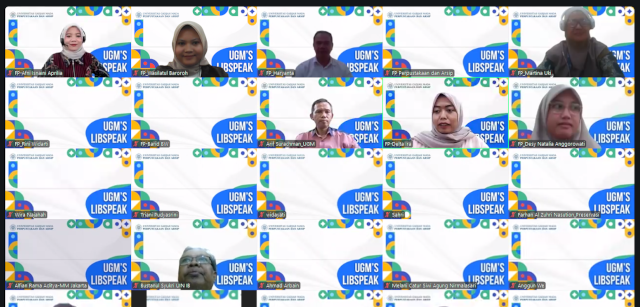
 The Forum of Librarians at Universitas Gadjah Mada (UGM) organized UGM’s LibSpeak 10, a national webinar titled “Automating Data Analytics with Artificial Intelligence for Library Service Development: Is It Necessary?”, on Tuesday (January 27, 2026), held online. The event was attended by 631 participants, including librarians, academics, students, and practitioners from various regions across Indonesia.
The UGM Librarians Forum serves as a platform for communication, collaboration, and capacity building among librarians within UGM. It regularly organizes discussion forums, knowledge-sharing sessions, and professional competency development activities. Through the UGM’s LibSpeak program, the forum opens a broader dialogue by engaging the national library community and cross-disciplinary stakeholders.
The event opened with welcoming remarks from the Chair of UGM’s LibSpeak 10 Organizing Committee, Barid Budi Wicaksono, who emphasized that the forum was designed as a space for knowledge sharing and critical reflection, rather than merely a venue for technology promotion.
“We would like to express our gratitude to the speaker, moderator, organizing committee, and all participants who took the time to actively take part in this event. The enthusiasm and engagement of participants are an important source of energy for the sustainability of discussion forums such as UGM’s LibSpeak in the future,” he said.
The official opening was delivered by the Head of the UGM Library and Archives, Arif Surachman, S.IP., MBA. In his remarks, he underscored the importance of using technology wisely while continuing to position librarians as the main actors in information services.
“Technology should help librarians strengthen their work and services, not replace their role. Ultimately, the human touch, experience, and professionalism of librarians remain the key to library services,” he stated.
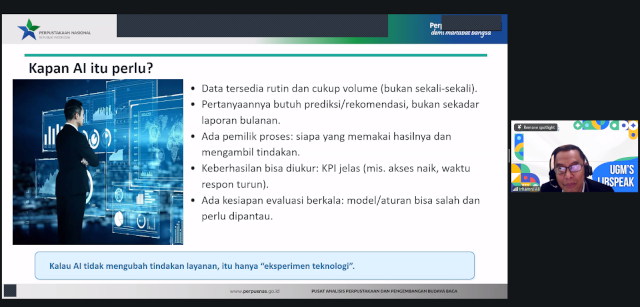
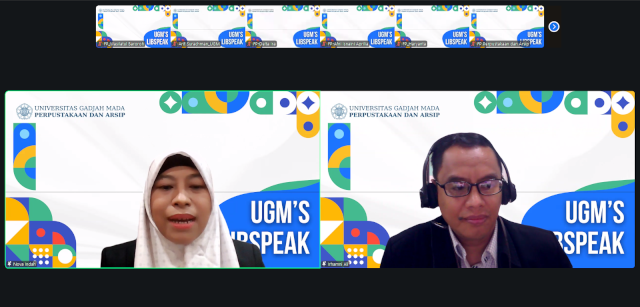
Entering the main session, the webinar featured Irhamni Ali, Ph.D. from the National Library of Indonesia as the keynote speaker, with Nova Indah Wijayanti, M.I.Kom., a librarian at UGM Jakarta Campus, serving as moderator. In her presentation, Irhamni explained the concepts and framework of AI-based data analytics automation in libraries, ranging from routine report management to the use of AI for trend analysis and service recommendations.
 “AI is not the end goal. What matters most is first identifying the real service issues we face, then ensuring that the data is ready and the performance indicators are clearly defined,” Irhamni explained.
She also outlined three levels of data analytics automation—report automation, insight automation, and guided decision-making—while highlighting key challenges in AI implementation, including human resource readiness, data integration, and ethical as well as user privacy risks.
The discussion session was highly interactive, with a wide range of questions from participants, including the relevance of AI for collection development, the most feasible infrastructure options, the accuracy of AI-generated analyses, and strategies for safeguarding data security and user privacy. This discussion reflected the diversity of needs and levels of readiness among libraries in adopting AI technologies.
Furthermore, UGM’s LibSpeak 10 contributes to the achievement of the Sustainable Development Goals (SDGs), particularly SDG 4 (Quality Education) through the strengthening of librarians’ data literacy, SDG 9 (Industry, Innovation, and Infrastructure) through the responsible use of information technology, and SDG 16 (Peace, Justice, and Strong Institutions) by promoting ethical and accountable data governance. In addition, the event also supports SDG 17 (Partnerships for the Goals) by strengthening collaboration among librarians, academics, students, and cross-disciplinary practitioners in the development of data- and technology-driven library services.
This activity is expected to encourage libraries to adopt AI gradually and critically, with a clear focus on the real needs of users, ensuring that technological innovation continues to go hand in hand with human values in library services.
Contributor: Wasilatul Baroroh