
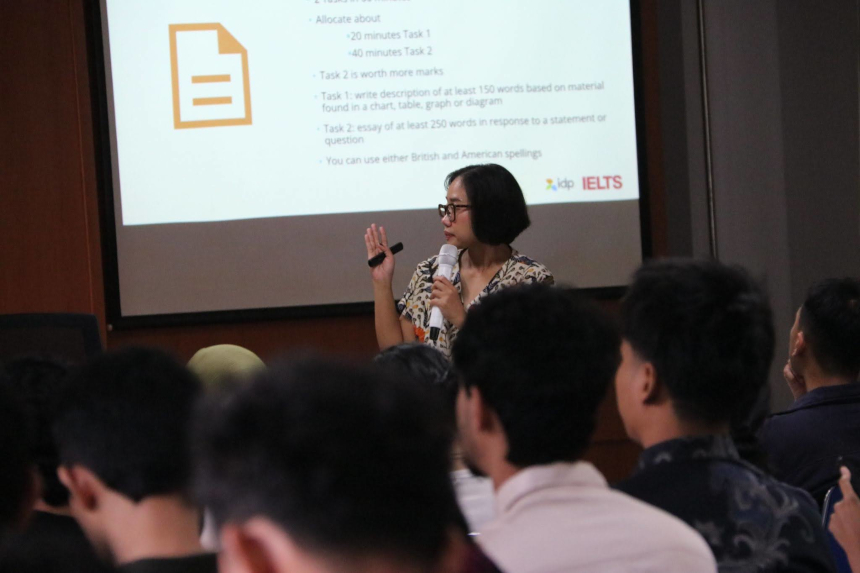
 Achieving an optimal IELTS score requires more than just English language proficiency. Effective test taking strategies, time management, and consistent practice all play an important role in preparing for the exam. To equip its academic community with the knowledge and skills needed to face this challenge, the Universitas Gadjah Mada (UGM) Library and Archives collaborated with IDP Yogyakarta to organize the IELTS Excellence Workshop: Tips, Tricks & Winning Strategies on Tuesday, October 20, 2026, at the Seminar Room on the second floor of the UGM Library and Archives.
The event was part of Let’s Understand Better (LUB), a program organized by the UGM Library and Archives. It featured several speakers from IDP Yogyakarta who shared strategies for tackling the four IELTS components: Listening, Reading, Writing, and Speaking.
Safirotu Khoir, Ph.D., Coordinator of Public Relations and International Affairs at the UGM Library and Archives, introduced the event as part of the LUB program. Through this initiative, the UGM Library and Archives seeks to provide its academic community with insights and skills that support their academic needs.
Wahyu Supriyanto, S.E., M.Si., highlighted the importance of English proficiency for those planning to pursue further education abroad. He emphasized, “English language tests such as IELTS are among the key requirements for pursuing further studies overseas.”
In line with this, Setia Endra, Office Manager at IDP, described IELTS as a “golden ticket” to international education and career opportunities. “IELTS is a golden ticket to pursuing studies or developing a career abroad,” he said.
He also explained that IDP is a co-owner of IELTS and provides international education consultancy services. These services help prospective students explore study opportunities in various countries, including Australia, Ireland, the United States, and Canada.
In the following session, Agatha Elma Febiyaska, IELTS Operations Executive at IDP Yogyakarta, shared general strategies for preparing for IELTS. These included understanding the test format and duration, practicing under timed conditions, and incorporating English reading, listening, and speaking into daily routines. Participants were also encouraged to learn vocabulary in context, review their answers, and follow the test regulations.

 Gde Raka Birama Anuraga, Educational Consultant at IDP Yogyakarta, discussed strategies for the Listening and Writing sections. He emphasized the importance of becoming familiar with different English accents, reading instructions carefully, and paying attention to spelling. For Writing, participants were advised to organize their responses clearly, use a varied vocabulary, and ensure that their answers addressed the questions and met the minimum word count requirements.
Meanwhile, Mimi Hamida, Senior Counsellor at IDP Yogyakarta, shared strategies for the Reading and Speaking sections. For Reading, participants were encouraged to use skimming techniques and recognize paraphrased information in texts. For Speaking, they were advised to develop their answers with reasons and examples, pay attention to pronunciation and intonation, and remain confident even when making mistakes. Consistent practice was highlighted as one of the keys to improving IELTS readiness.
Through this workshop, the UGM Library and Archives hopes to help its academic community better understand the IELTS test format and apply more effective preparation strategies. The initiative supports Sustainable Development Goal (SDG) 4, Quality Education, by promoting skills development and lifelong learning. Furthermore, the collaboration with IDP Yogyakarta contributes to SDG 17, Partnerships for the Goals, through interinstitutional cooperation that expands access to information and knowledge to support the development of global competencies.
Preparing for IELTS is not simply about achieving a high score. It is also about developing communication skills that are essential in international academic and professional environments. With access to reliable information and structured practice, the UGM academic community can be better prepared to pursue educational and career opportunities worldwide.
Contributor: Wasilatul Baroroh