
A book is not born out of silence, but from encounters of ideas across professions, continuously refined through dialogue and reflection. This spirit was championed by the Universitas Gadjah Mada (UGM) Library and Archives through the ArchiTalk & LibSpeak Special Event, an online discussion forum that explored the creative process behind the book Masa Depan Pengetahuan: Transformasi Perpustakaan dan Arsip dalam Ekosistem Pengetahuan Baru, held on Wednesday (28 January 2026).
Conducted via Zoom Meeting, the event featured Herman Setyawan and Wasilatul Baroroh as speakers, with Delta Ira Anggreanie serving as host. The forum was open to librarians, archivists, and members of the UGM academic community interested in collaborative processes in producing scholarly and professional works.
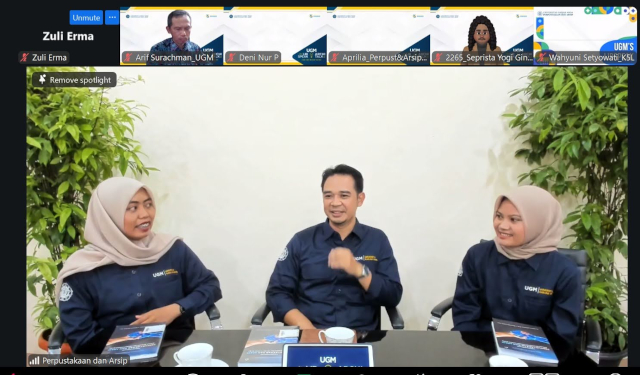 Head of the UGM Library and Archives, Arif Surachman, SIP., MBA., expressed his hope that the event would serve as a catalyst for the creation of new works, particularly within the library and archival professions. “We hope that the ArchiTalk & LibSpeak Special Event can spark the enthusiasm of our colleagues to be brave enough to write and produce works. Libraries and archives must continue to be enlivened through ideas that are written down and shared,” he said.
The discussion highlighted the birth of the book, which stems from an awareness of libraries and archives as university heritage—guardians of institutional memory that record the journey of ideas, policies, and intellectual works across generations. From this awareness, the book The Transformation of Libraries and Archives was compiled as an effort to preserve institutional memory while responding to the challenges of change. “This book was structured as an organized record of everyday practices, as well as a space for cross-professional dialogue so that librarians, archivists, and other stakeholders can learn from and understand one another,” said Herman Setyawan.
Collaboration between archivists and librarians in the book was not built through formal contracts, but through ongoing discussions about daily professional practices. Wasilatul Baroroh noted that differences in perspective became the main strength of the collaboration. “Archivists view information from the perspective of history and long-term memory, while librarians deal directly with diverse and dynamic user needs. These differences ultimately complement one another and enrich the way we manage knowledge,” she explained.
The writing process was carried out systematically, starting from the preparation of an outline, the exploration of academic references, to manuscript editing. Technology and artificial intelligence were used as supporting tools to map ideas and strengthen references, without diminishing the role of humans as the main actors in thinking and decision-making.
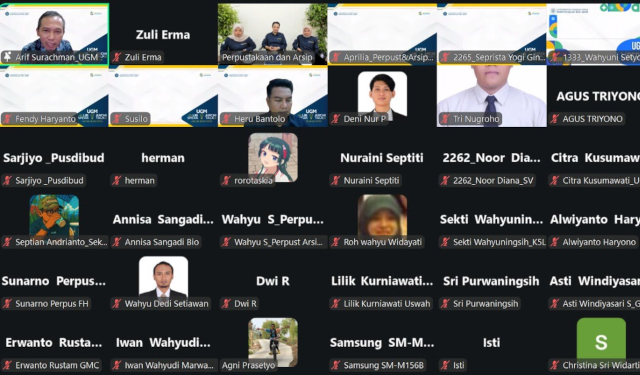 The ArchiTalk & LibSpeak Special Event aligns with the Sustainable Development Goals (SDGs), particularly SDG 4 (Quality Education) through the strengthening of literacy and lifelong learning, SDG 9 (Industry, Innovation, and Infrastructure) through the responsible use of technology, and SDG 17 (Partnerships for the Goals) through cross-professional collaboration in knowledge management.
In closing, Herman Setyawan emphasized the importance of putting knowledge gained from professional development forums into practice. “Knowledge acquired from seminars or workshops becomes far more meaningful when it is put into practice. That is where works can be created and make a real contribution to the profession,” he said.
Meanwhile, Wasilatul Baroroh reminded participants that today’s writing challenges are accompanied by increasingly open access to supporting technologies. “Today, there are many technologies we can maximize for writing, such as Scopus AI and SciSpace. What matters is how wisely and responsibly we use them to produce meaningful works,” she noted.
Through this event, the UGM Library and Archives reaffirmed its role as a space for intellectual dialogue, one that not only encourages the exchange of ideas, but also invites the library and archival community to go further: to put knowledge into practice, harness technology, and produce works that are relevant for the future.
Contributor: Wasilatul Baroroh