
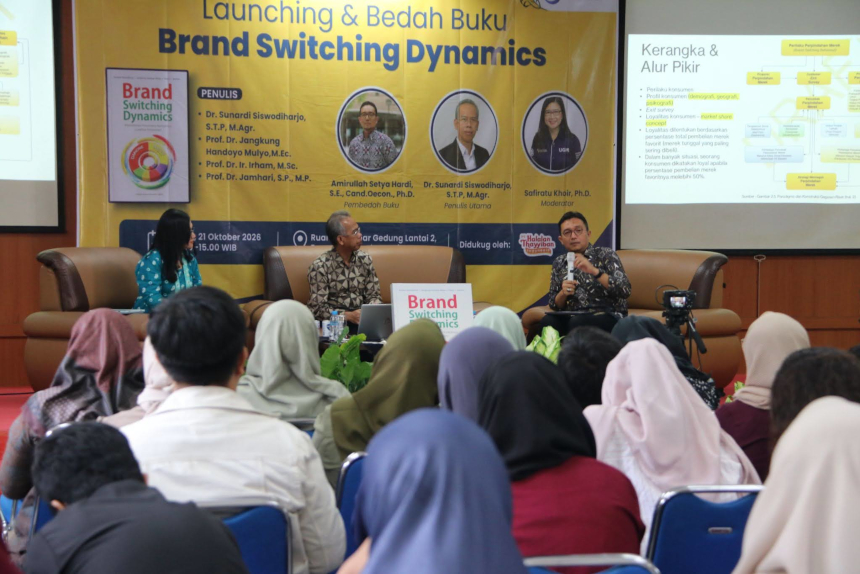
 Why does a consumer who has been loyal to a product for years suddenly decide to switch to another brand? This sensitive yet critical phenomenon in the modern business landscape was the main focus of the Book Review and Discussion Event organized with UGM Press, titled “Brand Switching Dynamics”, held in a hybrid format at the Seminar Room of the Library and Archives of Universitas Gadjah Mada (UGM) on Wednesday (21/10/2026).
As a hub of knowledge, the UGM Library and Archives initiated this event to explore the empirical reality of consumer behavior dynamics and its strategic implications for the modern industrial ecosystem.
In his opening remarks, the Head of the UGM Library and Archives, Arif Surachman, SIP., MBA, emphasized the importance of bridging academic research with dynamic commercial issues, such as the competitive dynamics within the instant noodle market in Indonesia. Through this scholarly platform, the library reaffirms its commitment to facilitating productive discussion spaces that generate positive societal impact.
Echoing this sentiment, representative of the co-authors, Prof. Dr. Jangkung Handoyo Mulyo, S.P., M.Ec., highlighted the pivotal role of the library within the university ecosystem. “When visiting a higher education institution, look at its library—it is the face of a university,” he remarked to the audience.
 The lead author of the book and a practitioner with 23 years of experience in multinational corporations, Dr. Sunardi Widosiharjo, S.T.P., M.Agr., explained that the phenomenon of brand switching is not merely a statistical figure of consumer migration, but an indicator of a continuously evolving market dynamic.
“Dissatisfied consumers are actually a vital source of learning,” stated Dr. Sunardi, while underscoring the key strategy to market leadership: “A brand must acquire new consumers while simultaneously retaining existing ones to prevent churn.”
Dr. Sunardi further elaborated on key perspectives for understanding public preferences: “Understanding brand switching is not just about identifying which brand is chosen, but knowing who switches, why, and under what context.” He also reminded attendees that “Behind the numbers of brand switching lies a behavioral pattern that can and must be interpreted.” Reaffirming the core essence of the book, he noted that “Brand Switching Dynamics” is not merely a narrative about departing consumers, but a clear signal of market transformation.
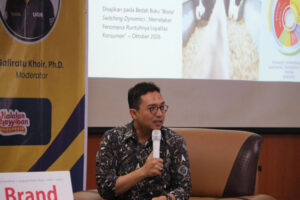 Meanwhile, UGM economist Amirullah Setya Hardi, S.E., Cand.Oecon., Ph.D., served as the discussant, offering comprehensive insights from a market economics perspective, specifically focusing on processed food industries such as Growing Up Milk (GUM) and infant formulas. Amirullah highlighted the stringent regulatory framework under BPOM Regulation No. 13/2023, monopolistic competition dynamics, and the fundamental distinction between customer churn and brand switching.
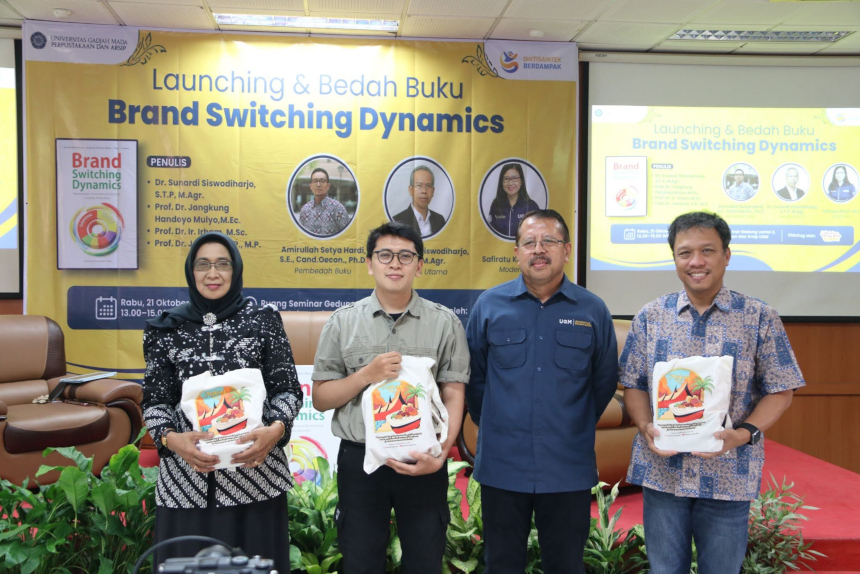 The interactive discussion session was moderated by Safirotu Khoir, Ph.D., Coordinator for Public Relations and International Affairs at the UGM Library and Archives. Participants posed various critical questions ranging from brand trust recovery strategies following consumer dissatisfaction, variety-seeking phenomena, price and quality adjustment challenges for MSMEs, to brand stretching strategies.
The hosting of this book review by the UGM Library and Archives also serves as a tangible academic contribution toward achieving the Sustainable Development Goals (SDGs). Through this scholarly platform, the library supports SDG 4 (Quality Education) by providing access to high-quality knowledge and empirical research-based discussion spaces for the public. Furthermore, discussions on consumer behavior strategies reinforce SDG 8 (Decent Work and Economic Growth) by serving as a business resilience guide for MSMEs and industries, while advancing SDG 12 (Responsible Consumption and Production) through an emphasis on regulatory compliance and ethical consumer rights fulfillment.
The dynamics of modern market movements demonstrate that consumer loyalty is not absolute; rather, it is a dynamic relationship requiring consistency, empathy, and continuous development from producers. When a brand ignores the voice of its consumers, it risks not only losing buyers but also losing its strategic relevance in the future. Will our industry players and MSMEs adaptively interpret these changing signals, or will they passively allow market share to shift elsewhere?
Contributor: Mukhammad Ramadhani Abdul Kafy