
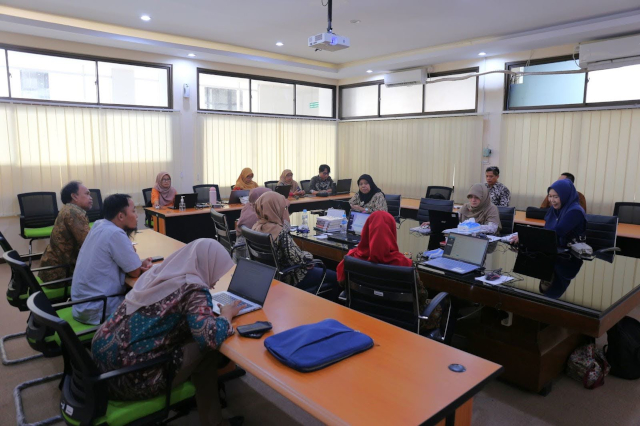
 Amid the rapid wave of digitalization, the UGM Library and Archives reaffirmed its commitment to maintaining high-quality services by organizing a knowledge-sharing session titled “Conventional Information Retrieval Training for Librarians and Library Staff” on Thursday (11/12/2025) at the Meeting Room, L6 Building, 2nd Floor. The program served as an important momentum to strengthen the fundamental skills of librarians and library staff in managing and retrieving print-based information sources, competencies that remain relevant despite the dominance of digital access.
The training featured speakers from the Data and Information Systems Division and the Library Services Division of the UGM Library and Archives. They delivered a range of materials covering classification basics, subject-heading determination, descriptive cataloging, secondary literature development, and conventional information retrieval techniques.
This activity arose from the need to enhance librarians’ ability to maximize the value of print collections, which continue to serve as vital resources for the academic community. “Print information sources still hold significant scholarly value. Many collections cannot be replaced by digital versions, which is why conventional retrieval skills must be preserved,” stated Yulistyarini Kumaraningrum, S.P., MM., Head of the Data and Information Systems Division, in her opening remarks.
In addition to theoretical sessions, participants engaged in hands-on practice, including determining accurate subject headings, performing classification and cataloging, developing secondary literature, and simulating conventional information searches. This approach further reinforces the hybrid service ecosystem adopted by the UGM Library and Archives, striking a balance between the strengths of both digital and print collections.

 Beyond strengthening individual capacities, this program aligns with UGM’s commitment to advancing the Sustainable Development Goals (SDGs), particularly SDG 4: Quality Education, by promoting information literacy and sustainable, experience-based learning.
The training concluded with a discussion session to ensure that the acquired competencies serve as a refresh and reinforcement for librarians and staff in carrying out daily information service tasks. Speakers also emphasized that mastering conventional search techniques is a crucial foundation that enhances the quality and accuracy of reference services.
Through this training, the UGM Library and Archives underscores its strategic efforts to maintain comprehensive, high-quality information services, an investment in professional competence that continues to strengthen the role of librarians in supporting the Tri Dharma Perguruan Tinggi while ensuring inclusive access to knowledge for all users.
Contributor: Wasilatul Baroroh