
What if thousands of undergraduate theses, master’s theses, and doctoral dissertations on manuscripts from universities across Indonesia could be accessed in one place? That is the vision currently being explored by the National Research and Innovation Agency (BRIN) in collaboration with the Universitas Gadjah Mada (UGM) Library and Archives through discussions on the potential integration of university repositories.
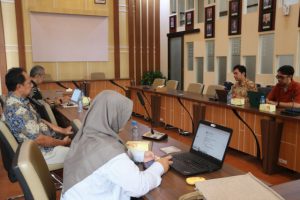 The discussion, held on Thursday (July 2) at the UGM Library and Archives Meeting Room, brought together representatives from BRIN, the UGM Library and Archives, and academics from UGM’s Department of Javanese Language, Literature, and Culture. The main objective was to establish a more connected manuscript research data ecosystem, ensuring that research outputs are no longer scattered across individual institutional repositories.
Alan Darmawan of BRIN explained that the agency is currently developing a national database that will compile manuscript research conducted by universities throughout Indonesia.
“We will develop a database containing manuscript research from various universities, particularly undergraduate theses, master’s theses, and doctoral dissertations related to manuscripts. We hope this database will serve as a shared reference for researchers, making existing studies more accessible, more widely utilized, and easier to build upon for future research,” Alan said.
Once established, the database will serve as a gateway for researchers, lecturers, and students to identify previous studies. In addition to saving time, it will also help uncover research opportunities that remain unexplored.
Zakariya Pamuji Aminullah, S.S., M.A., a lecturer in UGM’s Department of Javanese Language, Literature, and Culture, echoed this view. According to him, one of the greatest challenges faced by students, particularly those studying Javanese Literature, is identifying a genuinely novel research gap.
“One of the biggest challenges for Javanese Literature students is finding a research gap. They need to know what studies have already been conducted so they can identify original contributions for their own research. If a database compiling manuscript studies from universities were available, this process would certainly become much easier,” he said.
From the repository management perspective, the UGM Library and Archives also shared practical insights that should be taken into consideration. Dewi Nurhastuti, S.Sos., Data and Digital Resources Staff at the UGM Library and Archives, emphasized the importance of metadata management to ensure repository integration can be carried out effectively.
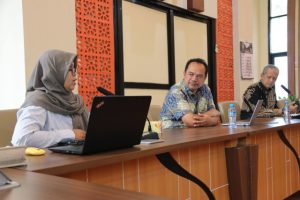
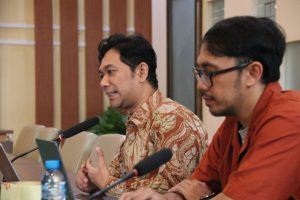 “One of the challenges is that our Electronic Theses and Dissertations (ETD) collection does not yet have call numbers. This is one aspect that needs to be addressed if repositories from different universities are to be integrated in the future,” Dewi explained. She added that strengthening metadata would significantly improve the effectiveness of information retrieval and discovery.
Responding to the initiative, Wahyu Supriyanto, S.E., M.Si., Head of the Library Division at the UGM Library and Archives, welcomed the opportunity to collaborate with BRIN.
“This is an excellent program with great potential. We highly welcome this collaboration, and the next step will be to discuss it further through the preparation of a Cooperation Agreement,” Wahyu said.
This collaboration is about more than simply developing a database. It represents an important step toward expanding access to knowledge, creating opportunities for new research, and strengthening collaboration among universities and research institutions across Indonesia.
The initiative also supports the Sustainable Development Goals (SDGs), particularly SDG 4: Quality Education by expanding access to knowledge resources, SDG 9: Industry, Innovation and Infrastructure by strengthening innovation-based information infrastructure, and SDG 17: Partnerships for the Goals by fostering cross-institutional collaboration to advance manuscript research and preserve Indonesia’s manuscript heritage.
Contributor: Wasilatul Baroroh