
Dozens of journal articles have been collected. The number of browser tabs keeps growing. Various articles have been read and summarized. Yet one question remains: among all these studies, what is still unanswered?
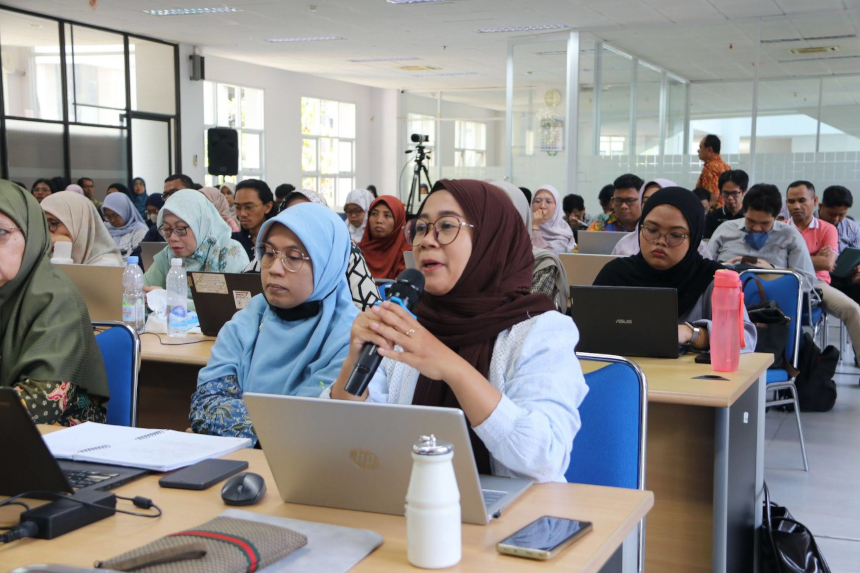 This question became the starting point for the Step by Step Systematic Literature Review Workshop, organized by UGM Library and Archives in collaboration with the Faculty of Geography UGM on Thursday, September 24, 2026. The workshop was held in a hybrid format.
Through this workshop, participants were invited to understand that a Systematic Literature Review (SLR) is not simply about finding as many journal articles as possible, reading them, and summarizing their contents. A systematic process is required so that the collected literature can be used to answer research questions in a structured and evidence-based manner.
Head of UGM Library and Archives, Arif Surachman, SIP., MBA., expressed his appreciation for the collaboration with the Faculty of Geography UGM in organizing the event.
“Thank you to the Faculty of Geography UGM for collaborating with UGM Library and Archives in organizing this activity. We hope that this Systematic Literature Review workshop will provide benefits for the academic community in supporting their research activities,” said Arif.
 The workshop was officially opened by the Vice Dean for Education, Teaching, and Student Affairs of the Faculty of Geography UGM, Dr. Erlis Saputra, S.Si., M.Si. He emphasized the importance of mastering SLR for students, lecturers, and researchers in improving the quality of academic work.
“Mastering the SLR method will provide a strong foundation for improving the quality of our scientific publications at the international level,” he said.
The main session featured Dr. Yaniasih, S.TP., M.P., a researcher at the Center for Data Science and Information Research, National Research and Innovation Agency of Indonesia (BRIN), who guided participants through the SLR process step by step. The session was moderated by Aprilia Mardiastuti, S.I.P., M.A., a UGM librarian, who facilitated the discussion and guided participants throughout the session. Yaniasih began with an aspect that is often overlooked when conducting a literature review: formulating a research question.
Before opening Scopus or Web of Science and entering keywords, researchers need to determine what they want to find out. Based on the research question, they can then develop search keywords, synonyms, inclusion and exclusion criteria, and an appropriate search strategy.
“SLR is not simply about collecting articles. We need to have a clear question and then determine how the evidence will be searched, screened, assessed, and synthesized,” explained Yaniasih.
Participants then practiced translating a research problem into keywords and a search strategy. Boolean logic, for example, can be used to connect search terms, with OR combining synonyms within a concept and AND connecting different research concepts.
The process does not end once the articles have been found. The collected literature still needs to go through screening, quality assessment, and data extraction to identify relevant information. During the practical session, participants were introduced to Parsifal to support the management and screening of literature.
This is where critical reading becomes essential. Researchers need to go beyond understanding what each individual article says. They need to compare findings, question methodological limitations, examine differences in results, and identify contexts or populations that remain underexplored.
Through this critical reading process, researchers can map the State of the Art (SoTA), identify a research gap, and formulate the novelty and contribution of their research.
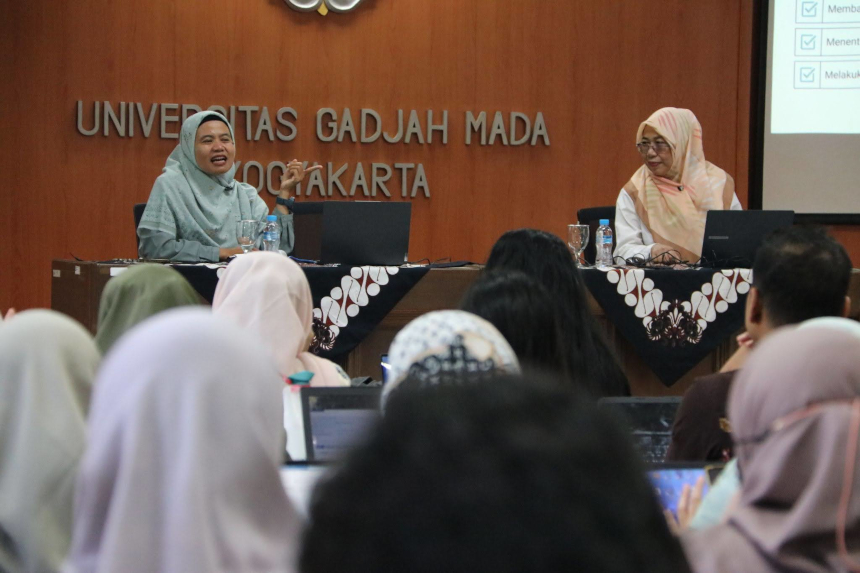 “Without the willingness to question the boundaries of previous research, we will only become data summarizers rather than researchers who discover novelty,” said Yaniasih.
To support this process, the workshop also introduced various applications that can be used throughout an SLR. In addition to databases for literature searches, participants were introduced to tools for screening, literature extraction and processing, and research mapping. Elicit and SciSpace can assist with organizing and extracting information, while VOSviewer and Bibliometrix can help identify patterns and relationships within a body of literature.
Artificial intelligence (AI) also received particular attention. Rather than positioning AI as a replacement for researchers, Yaniasih introduced the AI Sandwich approach, in which researchers determine the direction and criteria, AI assists with analytical tasks in the middle of the process, and researchers then review the results and make the final decisions.
“AI is an assistant, not a reviewer. Its results still need to be verified,” she emphasized.
This principle also applies when participants move into the writing stage. After searching, screening, assessing, extracting, and synthesizing the literature, the findings need to be presented systematically in a report or article draft. Participants were also introduced to the distinction between results and discussion. Results present findings objectively, while the discussion interprets those findings, connects different pieces of evidence, and explains their implications.
The activity was part of an effort to strengthen support for the academic community’s research needs. The ability to search for, evaluate, process, and critically use information is closely connected to SDG 4: Quality Education, while strengthening evidence-based research practices and the use of technology supports SDG 9: Industry, Innovation and Infrastructure. The collaboration between the Faculty of Geography UGM and UGM Library and Archives also aligns with SDG 17: Partnerships for the Goals by strengthening cooperation to support capacity building and the research ecosystem within higher education.
Ultimately, SLR is not a competition to collect as many journal articles as possible. Its value lies in the researcher’s ability to connect scattered evidence, identify patterns, recognize what remains unanswered, and use those findings as a foundation for future research. Among the hundreds of articles already published, there may still be a gap in knowledge waiting to be discovered.
Contributor: Wasilatul Baroroh