
Behind every journal issue published on time lies a long process that often goes unseen. Manuscripts need to be processed, reviewers coordinated, team members need to carry out their respective roles, and various accreditation and indexing requirements must be carefully met.
For journal managers, each of these details is part of their day-to-day work. When the goal is to improve service quality and optimize journal management, learning how other institutions handle similar processes can offer new perspectives and strategies.
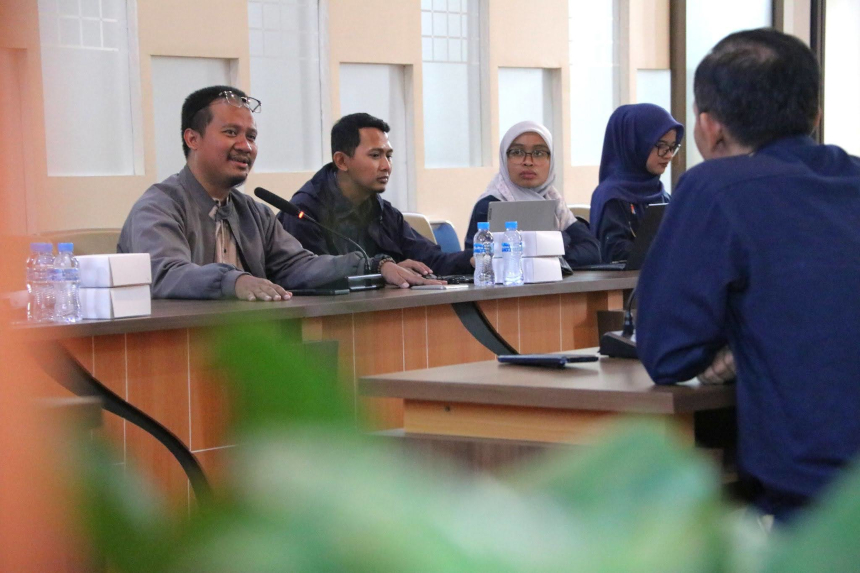 This was what brought the Language and Library Unit of the Politeknik Energi dan Pertambangan (PEP) Bandung to the Library and Archives of Universitas Gadjah Mada (UGM) on Wednesday (September 23, 2026), for a benchmarking visit with the editorial team of Berkala Ilmu Perpustakaan dan Informasi (BIP). The visit aimed to explore journal governance and development strategies that could support improvements in service quality and the optimization of journal management at PEP Bandung.
Four representatives from PEP Bandung took part in a focused discussion lasting approximately two hours. The meeting provided an opportunity for the PEP Bandung journal management team and the BIP UGM editorial team to exchange experiences through a sharing session titled “Electronic Journal Management, Accreditation and Indexing Strategies.” Sri Junandi, S.I.P., Managing Editor of Berkala Ilmu Perpustakaan dan Informasi UGM, was present to share his experience in journal management and address various issues of concern to journal managers.
One of the discussions that directly addressed the work behind the scenes was the management of Open Journal Systems (OJS). According to Sri Junandi, OJS needs to be supported by a well-organized workflow and clear role distribution. Journal managers do not need to handle the entire process on their own. Website management, journal management, and publication management should be systematically divided among team members, including editors, reviewers, copy editors, layout editors, and proofreaders.
From there, the discussion moved to two key milestones for many journal managers: accreditation and indexing. Sri Junandi explained that accreditation preparation requires every criterion to be met in a measurable manner. Evaluation forms, review forms, and response letters from authors are among the elements that need careful attention. The review process should also give reviewers sufficient room to assess the substance of manuscripts thoroughly, helping maintain the quality of published articles.
 “The criteria in the evaluation and review forms must be met in a measurable manner, from the abstract to the bibliography, so that authors know where their manuscripts need improvement. Reviewers should also be given sufficient room to review manuscripts in depth to improve their substantive quality,” said Sri Junandi.
The discussion also covered technical details that are often overlooked. These included the use of an informative English running head as one of the requirements for pursuing Scopus indexing, a maximum plagiarism tolerance of 20 percent, and the need to demonstrate website traffic statistics through unique visitor data.
For Sinta accreditation, Sri Junandi outlined several basic requirements that journal managers need to ensure are fulfilled. These include valid and consistent e-ISSNs, continuous publication for at least three years with a minimum frequency of two issues per year and five articles per issue, editors and reviewers from diverse affiliations, adherence to publication ethics, transparency regarding author fees, active editor accounts, and functioning DOIs for all published articles.
Meanwhile, the path toward indexing can be pursued progressively. Journal managers can begin by ensuring DOI registration through Crossref and visibility on Google Scholar, followed by Garuda and DOAJ, before pursuing Scopus indexing.
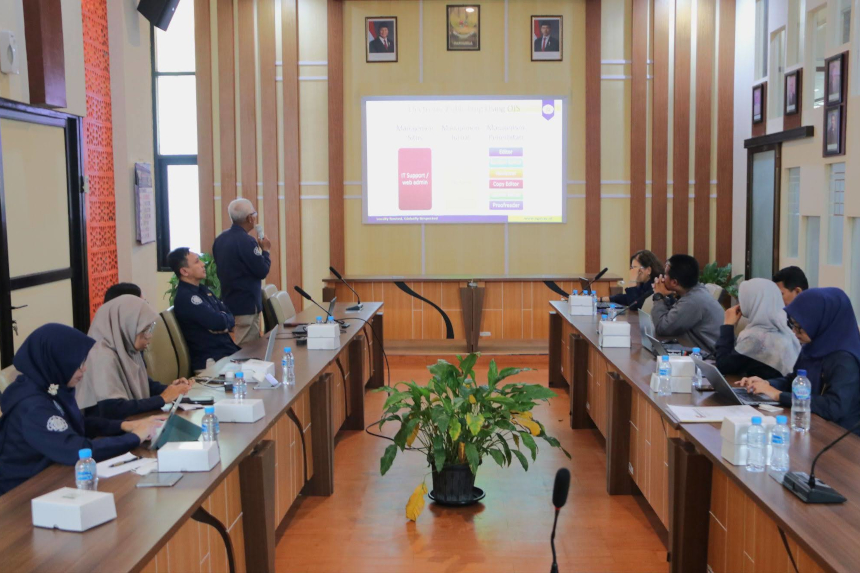 Amid the technical discussion, journal management was once again placed in a broader context of responsibility. Every decision made throughout the publication process leaves a lasting mark on the academic record.
“Journal management requires intellectual responsibility because every published article becomes part of the scholarly record, where it can remain for a long time and be cited by many people,” emphasized Safirotu Khoir, Editor in Chief of BIP UGM.
The message underscored that the work of journal managers does not end with ensuring that an issue is successfully published. Every process behind the publication contributes to the quality and credibility of the knowledge that reaches readers and future researchers.
The exchange of experiences through this benchmarking visit also contributed to efforts to strengthen scholarly publishing capacity within higher education institutions. The collaboration supports Sustainable Development Goal (SDG) 4: Quality Education through strengthening the quality of scholarly publications and scientific literacy, as well as SDG 17: Partnerships for the Goals through knowledge transfer and capacity building among institutions.
Contributor: Wasilatul Baroroh