
Amid increasingly complex challenges to academic integrity—particularly with the widespread use of generative artificial intelligence—the Library and Archives of Universitas Gadjah Mada (UGM) has taken a strategic step by strengthening the role of Turnitin administrators and instructors as the frontline in plagiarism prevention. This effort was realized through the Workshop on Optimizing Turnitin as an Instrument for Plagiarism Prevention, held on Thursday, 12 February 2026.
 Conducted online via Google Meet, the workshop was attended by Turnitin administrators and instructors across UGM. The event featured Muhammad David Lung, Manager of Customer Onboarding at Turnitin Indonesia (Training), as the main speaker, with Yulistiarini Kumaraningrum, S.PT., MM., Head of the Data and Information Systems Division of the UGM Library and Archives, serving as moderator.
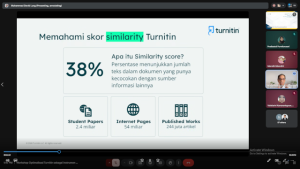
In his presentation, Muhammad David Lung emphasized that Turnitin does not merely function as a text similarity detection tool, but also as an educational instrument to foster a culture of academic integrity. He provided a comprehensive explanation of key features such as Similarity Detection, Integrity Flags, and AI Writing Detection, which have become major concerns in higher education today.
He also underscored the importance of instructors’ ability to interpret Similarity Reports accurately, including distinguishing properly quoted and cited text from technical errors such as missing quotation marks, as well as identifying indications of a complete lack of attribution. According to him, this understanding is crucial to ensure that Turnitin is used fairly and does not disadvantage students.
Alongside the rapid development of generative AI technologies, David highlighted the use of Turnitin’s AI Writing Report. He encouraged lecturers and administrators to set clear expectations regarding the use of AI in academic writing. “Institutions need to clarify when AI may be used, when it is not allowed, and how its use should be ethically acknowledged,” he said.
 Furthermore, the workshop forms part of an ongoing commitment to maintaining academic quality and supporting the academic community in responding to the evolving landscape of higher education. Moderator and Head of the Data and Information Systems Division of the UGM Library and Archives, Yulistiarini Kumaraningrum, affirmed that the role of Turnitin administrators is highly strategic. “Turnitin administrators and instructors are not merely system operators, but academic partners who help lecturers and students understand honest, responsible, and ethical scholarly writing practices,” she stressed.
The activity aligns with the Sustainable Development Goals (SDGs), particularly SDG 4 (Quality Education) through strengthening academic quality assurance systems; SDG 16 (Peace, Justice, and Strong Institutions) by promoting integrity-based academic governance; and SDG 17 (Partnerships for the Goals) through strategic collaboration between educational institutions and global educational technology providers.
Through this workshop, a shared understanding is expected to emerge that academic integrity is not merely about similarity percentages or AI scores, but about an educational process that prioritizes dialogue, fairness, and scholarly responsibility—an essential foundation for producing academic works that are not only original, but also uphold dignity and ethical values.
Contributor: Wasilatul Baroroh