
On Thursday (February 12, 2026), Perpustakaan dan Arsip Universitas Gadjah Mada (UGM) welcomed a study visit from the Library and Digital Service of Universitas Muhammadiyah Surakarta (UMS). This visit took place in Meeting Room L6 on the second floor. The activity focused on strengthening digital library service governance, specifically by integrating membership and circulation systems with academic systems, optimizing consultative services through the Library Clinic, and developing strategies for managing and evaluating collections to ensure they remain relevant to the academic needs of the community.
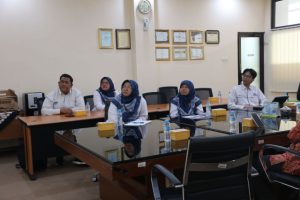 The Head of the Perpustakaan dan Arsip UGM, Arif Surachman, S.IP., MBA., stated that this visit provided a forum for sharing best practices in developing adaptive and sustainable services. “We continue to encourage system integration, strengthening academic support services, and periodically organizing collections so that the library becomes not only a provider of information resources, but also a strategic partner in supporting learning and research,” he said.
During the discussion, the Head of the UGM Library, Wahyu Supriyanto, S.E., M.Si., explained the membership system and circulation services, which are integrated with the academic system, ensuring efficient book activation and lending. All students, including exchange students, can access the services, with loan terms tailored to their level of study and flexible renewal options. He also highlighted the library’s collection management policies. “We implement regular reorganization and evaluation of existing collections to ensure that the available books remain relevant and support the academic needs of the community,” he explained.
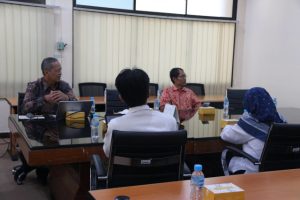 In addition to circulation services, the UGM Library also introduced the Library Clinic program, an academic consultation service that includes scientific source searches, citation management, bibliometric analysis, and assistance with publication of scientific papers. Furthermore, the Perpustakaan dan Arsip UGM team responded to questions about the Rotate Your Book program. “This program is a collaboration with the city library that allows students to exchange books with the provided collection to expand their access to reading material,” said Erna Widayati, S.E., M.M., Head of the UGM Archives Division.
The four representatives from the Library and Digital Service of Universitas Muhammadiyah Surakarta (UMS) who participated in the study visit were María Husnun Nisa, S.Sos., M.A. (Head of the Library and Digital Services Unit), Hardika Dwi Hermawan, S.Pd., M.Sc. (Head of Digital Management and Services), Esti Handayani, S.I.Pust. (Head of Finance and Librarian), Hanun Adlan, S.IP., and Aisha Rachmalia Rayhan, S.Hum. (Librarian). The participation of these representatives demonstrates UMS’s commitment to strengthening library service management and innovation, adapting to technological developments and the needs of the academic community.
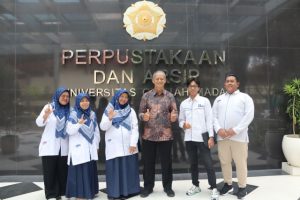 María Husnun Nisa, S.Sos., M.A., Head of the Library and Digital Services of Universitas Muhammadiyah Surakarta, expressed her appreciation for the openness of the Perpustakaan dan Arsip UGM in sharing good practices in digital-based service management. She assessed that the presentation on the integration of membership and circulation systems, program development and collaboration, and collection evaluation strategies provided applicable insights for strengthening services at the Universitas Muhammadiyah Surakarta.
This initiative supports the implementation of the SDGs, particularly SDG 4 (Quality Education), by improving the quality of access to and services for academic information, and SDG 17 (Partnerships to Achieve the Goals) by strengthening synergies and collaborative networks between universities.
This visit demonstrates the Perpustakaan dan Arsip UGM’s commitment to providing services that continually evolve according to student needs. Various innovative programs and strengthening institutional networks are continuously pursued to ensure the library remains a responsive, inclusive, and impactful learning space for the academic world.
Contributor: Gloria Ayuningtyas Christiana Lumbantoruan