
Responding to the rapid growth of scientific publications and the increasing need for data-driven research, the UGM Library and Archives organized a national webinar titled “Bibliometric Analysis as a Strategic Library Service” as part of the Ngabuburit with the UGM Librarians Forum series. The event was held online via Zoom on Wednesday (11/3/2026).
The webinar was attended by more than 200 participants from various institutions across Indonesia, including librarians, archivists, lecturers, students, researchers, and information professionals. The event served as a learning platform and discussion forum on the use of bibliometric analysis as a data-based service that can strengthen the role of libraries in supporting the research ecosystem.
The head of the organizing committee, Desy Natalia Anggorowati, S.IP., M.A., explained that the event aimed to broaden librarians’ understanding of the potential of bibliometric analysis in library services. “Through this forum, we hope librarians will understand that bibliometric analysis is not only a research method but can also be developed as a strategic library service to support research activities within institutions,” she said.
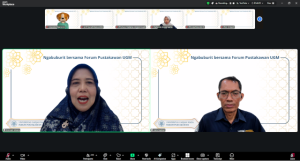
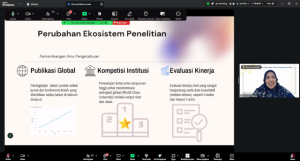 The discussion session was moderated by Janu Saptari, S.IP., a UGM librarian, who guided the session interactively. The main presentation was delivered by Dr. Purwani Istiana, S.IP., M.A., a UGM librarian with expertise in scientific information management and academic publication analysis.
In her presentation, Purwani explained that bibliometric analysis is a quantitative method used to analyze scientific publications in order to map research developments, identify research topic trends, and examine collaboration patterns among researchers in a particular field. “Through bibliometric analysis, librarians can assist researchers in mapping research areas, identifying relevant journals, and understanding the development of research within a specific discipline. This service can become a tangible form of library support for research activities in higher education institutions,” she explained.
During the discussion session, participants showed strong enthusiasm by raising various questions regarding the technical aspects of conducting bibliometric analysis, the use of analytical software, and opportunities for implementing bibliometric services in their respective libraries. The speaker also shared practical experiences in utilizing various scientific databases and analytical tools to support publication-based research.
The Ngabuburit with the UGM Librarians Forum program is a regular learning initiative held during the month of Ramadan, serving as a platform for knowledge sharing among librarians and information professionals. The tradition of ngabuburit is interpreted not merely as waiting for the time to break the fast, but also as an opportunity to enrich professional insight through scholarly discussions.
This activity aligns with the Sustainable Development Goals (SDGs), particularly SDG 4: Quality Education, by strengthening librarians’ capacity to support research and information literacy, as well as SDG 9: Industry, Innovation, and Infrastructure, which encourages the development of data-driven library services and knowledge innovation.
Through this initiative, the UGM Librarians Forum hopes that librarians will be increasingly prepared to play a strategic role within the research ecosystem. Amid the growing volume of scientific knowledge production, the ability to map information through bibliometric analysis has become a key factor for libraries to remain relevant in supporting the advancement of knowledge.
Contributor: Wasilatul Baroroh