
The rapid transformation of digital technology is increasingly reshaping how libraries manage knowledge and deliver information services. Responding to this dynamic change, the Librarians Forum of Universitas Gadjah Mada (UGM) organized a national webinar titled “AI Without the Drama: Practical, Affordable, and Ready to Use” as part of the Ngabuburit Bersama Forum Pustakawan UGM series, held online on Wednesday (March 4, 2026).

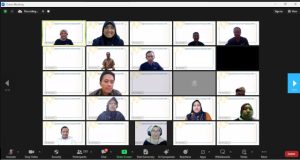 The webinar attracted around 300 participants from various institutions across Indonesia, including librarians, archivists, lecturers, students, and information technology practitioners. The forum served as a platform for sharing experiences and providing practical insights into the use of Artificial Intelligence (AI) to support information management and library services in the digital era.
Chair of the organizing committee, Safirotu Khoir, Ph.D., explained that the event was designed as a discussion space encouraging librarians to understand AI technology in a realistic and practical way. “Through this forum, we hope librarians can see that AI is not always expensive or complicated. In fact, many solutions can be directly utilized to support daily library work,” she said.
The event was officially opened by the Head of the UGM Library and Archives, Arif Surachman, S.IP., MBA. In his remarks, he emphasized the importance of librarians remaining adaptive to the rapid development of information technology. “The use of AI should be viewed as an opportunity to improve work efficiency while expanding access to knowledge for the academic community and the public,” Arif stated.
The discussion session was moderated by Maniso Mustar, S.I.Pust., a librarian at UGM, who guided the interactive dialogue. The main presentation was delivered by Yuan Oktafian, Secretary General of the Indonesian Digital Library Forum, who discussed practical ways to utilize AI without requiring complex technological infrastructure.
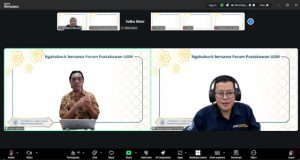 In his presentation, Yuan introduced the concept of Custom GPT, an AI assistant that can be configured according to organizational needs by incorporating specific instructions and knowledge documents. This technology can support various library tasks, including collection cataloging, metadata creation, and reference services for users. “AI can help librarians work more efficiently, for example in generating metadata, classifying books, or recommending references. However, the results still need to be verified by librarians to ensure they comply with information management standards,” he explained.
He also introduced the Retrieval-Augmented Generation (RAG) approach, which enables AI to generate answers based on documents provided as knowledge sources, such as books, journal articles, and research reports. This approach is considered to have strong potential to enhance digital information services in libraries.
The discussion session was lively, with participants raising questions about new skills librarians need to effectively utilize AI tools, the potential integration of AI with library systems such as OPAC or institutional repositories, and issues related to data security and privacy in AI usage.
The Ngabuburit Bersama Forum Pustakawan UGM program is a regular event held during the month of Ramadan as a shared learning space for librarians. The tradition of ngabuburit—spending time before breaking the fast—is interpreted not merely as waiting for iftar, but as an opportunity to engage in meaningful activities that enrich knowledge and professional competence.
This activity also aligns with the Sustainable Development Goals (SDGs), particularly SDG 4: Quality Education, by strengthening digital literacy and improving librarians’ competencies, as well as SDG 9: Industry, Innovation, and Infrastructure, which encourages the use of innovative technologies in knowledge management and information services.
Contributor: Wasilatul Baroroh