
The perfection of worship in Islam always begins with one fundamental aspect: purification. During the holy month of Ramadan, when Muslims strive to improve the quality of their worship, understanding thaharah becomes increasingly important. Responding to this need, the Dharma Wanita Persatuan (DWP) of the Library and Archives of Universitas Gadjah Mada in collaboration with the Forum Silaturahmi Muslimah (Forsilam) UGM organized the Fiqh Study Series on Worship: Thaharah on Friday (March 13, 2026).
Held in the Seminar Room of Building L1, 2nd Floor, UGM Library and Archives, the event featured Ustadzah Ummi Masbihah, caretaker of the Darush Shalihat Islamic Boarding School and wife of Ustadz Syatori Abdul Rauf, as the keynote speaker. The discussion was moderated by Umi Nurida Suciati, S.Pd., M.A., a librarian at UGM.
The event began with the recitation of verses from the Holy Qur’an by Athifah Dihyan Calysta, a part-time student staff member at the UGM Library and Archives. On this occasion, Athifah recited Q.S. Al-Maidah verses 6–7, which explain the command of purification before performing acts of worship, while reminding Muslims of the importance of maintaining both physical and spiritual cleanliness as part of obedience to Allah SWT.
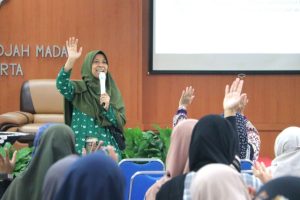 This study session was designed as a learning space for Muslim women to deepen their understanding of basic fiqh, which serves as the foundation of daily worship, particularly regarding the proper procedures of purification according to Islamic teachings.
“Many people feel that they have already performed ablution or purification correctly, yet there are often small details that are overlooked. In fact, the validity of our worship depends greatly on the perfection of thaharah,” said Ustadzah Ummi Masbihah during her presentation.
According to her, practical knowledge of fiqh is essential so that acts of worship are not merely routines but are truly carried out in accordance with Islamic guidance. She also encouraged participants to continue learning and reminding one another in goodness.
“Studying fiqh is not only about gaining knowledge, but also about maintaining the quality of our worship to Allah SWT,” she added.
Beyond enriching religious knowledge, the event also served as a platform to strengthen ukhuwah (sisterhood) among Muslim women within the UGM community. Participants not only listened to the material but also discussed various practical issues related to worship that are often encountered in daily life.
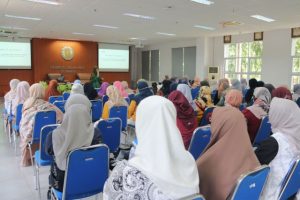 Moderator Umi Nurida Suciati stated that forums like this can serve as an inclusive and sustainable space for religious literacy within the academic community.
“The Library and Archives is not only a center for academic literacy, but also a place where spiritual literacy and life values can grow,” she said.
The event also aligns with the Sustainable Development Goals (SDGs), particularly SDG 4: Quality Education, by providing opportunities for lifelong learning, and SDG 3: Good Health and Well-being, by encouraging a balance between spiritual strengthening and mental well-being. Furthermore, the collaboration between DWP of the UGM Library and Archives and Forsilam UGM reflects the implementation of SDG 17: Partnerships for the Goals.
Through this simple yet meaningful fiqh study, participants were reminded that quality worship always begins with proper understanding. From small awareness about purification arises a greater commitment to improving one’s relationship with the Creator.
Contributor: Wasilatul Baroroh