
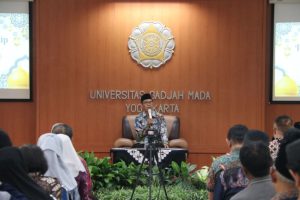
 The warm atmosphere of Eid al-Fitr was strongly felt in the Seminar Room, L1 Building, 2nd Floor of the Library and Archives of Universitas Gadjah Mada (UGM), on Thursday (March 26, 2026). Through a Syawalan event themed “Strengthening Harmony, Reinforcing Synergy, and Values in Service,” the gathering brought together the management team, staff, retirees, and supporting personnel, including part-time students, cleaning service staff, and canteen employees.
Syawalan is a tradition practiced by Indonesian communities, particularly in Java, after Eid al-Fitr. It serves as a moment to strengthen social ties, seek and grant forgiveness, and cultivate gratitude. These values were central to the Syawalan event held at the UGM Library and Archives.
The event began with a recitation of the Holy Qur’an by Muhammad Zaid, followed by a saritilawah (Qur’anic chanting) by Azhar Nafi’ah. The recitation created a solemn atmosphere while reminding participants that every professional endeavor should be grounded in spiritual values.
In his remarks, the Head of the UGM Library and Archives, Arif Surachman, S.IP., M.B.A., emphasized that Syawalan serves as an important catalyst for realigning the organization’s vision. “Through this Syawalan, we strengthen our bonds, align our steps, and reinforce synergy in delivering increasingly high-quality services,” he stated.
This commitment was further affirmed through the recitation of the Syawalan Pledge, led by Dr. Herman Setyawan, S.Pd., M.Sc., an archivist at UGM. The pledge symbolized the collective commitment of all members of the Library and Archives to forgive one another, strengthen solidarity, and enhance integrity and professionalism in carrying out their duties.
The atmosphere then shifted to a more relaxed and reflective tone with the screening of collaborative works, including a short film titled “Ikhlas yang Menemukan Jalan Pulang” (Sincerity Finds Its Way Home), which highlighted the values of sincerity and dedication, as well as a video cover of “Spontan (Tanpa) Uhuy versi Lebaran”, bringing a sense of togetherness and joy.
The highlight of the event was the Syawalan sermon delivered by Ustadz H. Ahmad Mustafid, S.Ag., M.Hum. In his sermon, he spoke about the true meaning of happiness, which is not measured solely by worldly achievements but also by the balance between the worldly life and the hereafter.
He invited participants to reflect on a commonly recited prayer, known as the “comprehensive prayer”: “Rabbana atina fiddunya hasanah wa fil akhiroti hasanah waqina adzabannar,” meaning, “Our Lord, grant us good in this world and good in the hereafter, and protect us from the punishment of the Fire.”
According to him, this prayer, derived from Surah Al-Baqarah verse 201, carries a profound philosophy of life balance. “True happiness lies in achieving balance between worldly success and preparation for the hereafter. Both must go hand in hand,” he explained.
He added that, in the context of work, happiness can be found through sincerity in service and maintaining good relationships with others. “When our hearts are pure and our intentions are sincere, work is no longer a burden, but a path toward blessings,” he added.
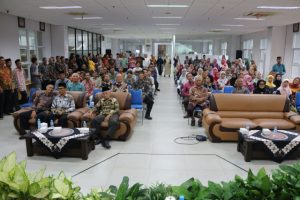
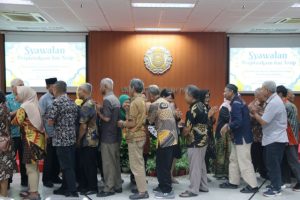 The event concluded with a collective prayer, followed by a group photo session and a friendly gathering that strengthened intergenerational connections within the workplace.
This activity also reflects a commitment to the Sustainable Development Goals (SDGs), particularly Goal 16 on Peace, Justice, and Strong Institutions through strengthening a harmonious organizational culture, as well as Goal 8 on Decent Work and Economic Growth by fostering an inclusive and collaborative work environment.
More than just an annual tradition, the Syawalan event serves as a reminder that happiness, harmony, and meaningful service begin with balance—between the world and the hereafter, between individuals and togetherness, and between work and the values upheld collectively.
Contributor: Wasilatul Baroroh