
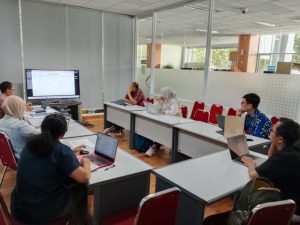
 The ability to find accurate scientific references has become a crucial skill for students and researchers amid the overwhelming flow of digital information. Responding to this challenge, the UGM Library and Archives organized the Mini Class on Information Literacy, March 2026 edition, a short course designed to help students access, manage, and analyze scientific literature more effectively.
The program took place at the WOW Room, 1st Floor of the UGM Library and Archives. All sessions were led by Janu Saptari, S.IP., a librarian at UGM, who provided practical training on utilizing technology in the process of searching for and managing scientific information.
The program featured three training sessions with different topics. The first session, titled “E-Resources and AI for Information Searching,” was held on March 4, 2026. In this class, participants were introduced to various types of digital scientific literature from trusted sources subscribed to by UGM as well as alternative sources. Participants also learned how to determine effective keywords and utilize Artificial Intelligence (AI)-based applications to find and analyze scientific literature more quickly.
“In today’s era of information overload, the ability to search for scientific literature using the right strategy has become an essential skill for students. AI can help accelerate this process when used wisely,” said Janu.
The second session, held on March 5, 2026, focused on “Reference Manager.” During this training, participants were introduced to Reference Management System (RMS) software that helps manage reference documents, generate citations, and automatically compile bibliographies for academic writing.
According to Janu, the use of reference managers can help students produce academic work more systematically and efficiently. “Many students still compile citations and bibliographies manually. With a reference manager, this process can be done automatically, making it more organized and minimizing errors,” he explained.
Meanwhile, the third session titled “Bibliometric Analysis” was held on March 12, 2026. The training discussed how to optimize bibliographic data to support research activities and academic writing. Participants learned how to determine research keywords, select databases for dataset collection, and gather and clean bibliographic data before conducting analysis.
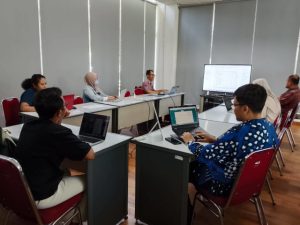 In this session, participants were also introduced to applications such as VOSviewer and Biblioshiny to visualize research networks and map research trends in specific academic fields. “Bibliometric analysis helps researchers understand the landscape of research development and identify potential topics that are still open for exploration,” Janu said.
This Mini Class on Information Literacy program is part of the efforts of the UGM Library and Archives to enhance information literacy and research competencies among students. The program is organized with a prior scheduling system, allowing participants to adjust their participation according to the available schedule. Information about the program schedule can be found on the Instagram account @perpustakaan_ugm.
The Mini Class on Information Literacy is part of the UGM Library and Archives’ efforts to enhance information literacy and research competencies among students. The initiative also aligns with the university’s commitment to supporting the Sustainable Development Goals (SDGs), particularly SDG 4: Quality Education, which emphasizes the importance of inclusive and high-quality education as well as strengthening literacy skills in the digital era.
Through practical training programs like this, the library functions not only as a center for information resources but also as a learning space that supports students in developing research skills that adapt to technological advancements and the evolving academic landscape.
Contributor: Wasilatul Baroroh