
Revitalizing a library that has experienced prolonged stagnation requires more than simply upgrading its facilities. It calls for comprehensive evaluation, needs assessment, and user-oriented planning. These principles were among the key focuses of Halu Oleo University’s (UHO) benchmarking visit to the Library and Archives of Universitas Gadjah Mada (UGM), held from November 5, 2026.
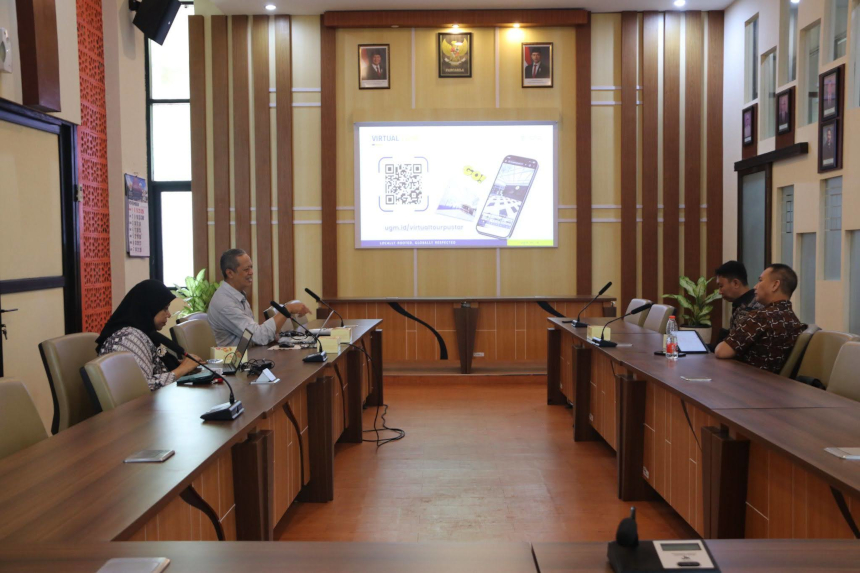 The visit was part of UHO’s efforts to improve its library management following approximately 14 years of stagnation in its development. The UHO delegation was led by Dr. Adrian Tawai, S.Sos., M.Si., Head of the UHO Library, accompanied by Abdiyanzahnur, AMK, Assistant Expenditure Treasurer. Through this visit, UHO sought to gain insights and learn best practices in university library management to support the development of its institution.
As part of this improvement process, UHO recognized that library revitalization should begin with a reassessment of the library’s objectives and its role in supporting the university’s vision. Understanding the library’s strategic function serves as a foundation for establishing more focused and sustainable management policies.
One of the initial steps involved conducting an inventory of the library’s existing book collections. This process aimed to identify the availability, condition, and relevance of the collections to the university community’s academic needs. Consequently, collection development could be guided by a clear assessment rather than simply focusing on increasing the number of available books.
In addition, UHO conducted a student satisfaction survey to evaluate the quality of its library services. The survey served as an evaluation instrument to understand users’ experiences, identify service-related challenges, and gather students’ feedback as a basis for improving service quality.
Dr. Adrian Tawai, S.Sos., M.Si. explained that library improvement must be carried out gradually, taking into account the institution’s existing conditions and needs.
“After experiencing stagnation for such a long time, we need to begin our efforts by addressing the most fundamental aspects. We want to reassess the library’s purpose within the university, identify the collections currently available, and directly understand students’ needs through satisfaction surveys. This way, library development can have a clearer direction and well-defined priorities,” he stated.
For the UGM Library and Archives, this visit provided an opportunity for knowledge exchange and strengthened collaboration among university libraries. UHO’s experience demonstrates that library revitalization should begin with an assessment of internal conditions and meaningful user engagement. Library development should not focus solely on infrastructure but also consider information accessibility, collection relevance, and service quality.
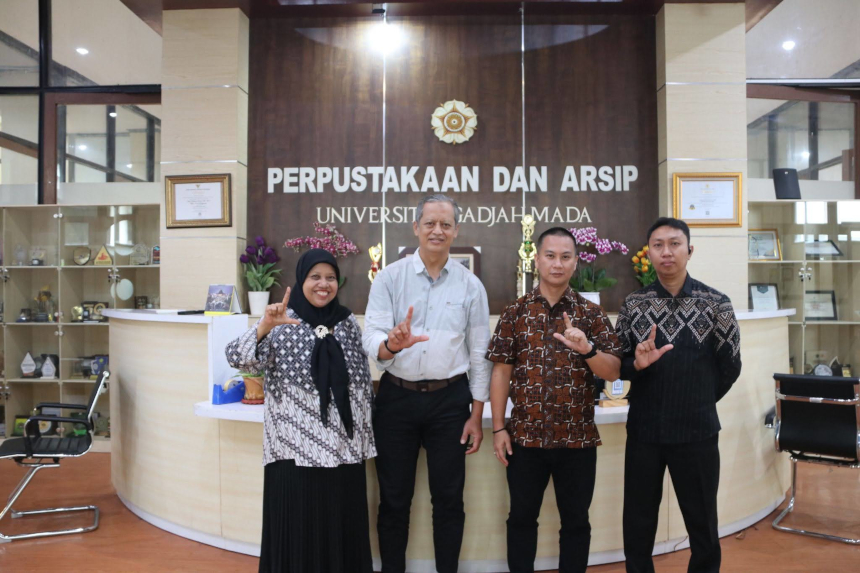 These efforts align with Sustainable Development Goal (SDG) 4: Quality Education, particularly in promoting inclusive learning environments and access to knowledge resources. Strengthening library governance also supports SDG 16: Peace, Justice, and Strong Institutions by encouraging the development of responsive, participatory, and accountable institutions.
“A thriving library is not merely one that possesses extensive collections and adequate facilities, but one that understands the needs of its users. Therefore, evaluation and service development must be treated as continuous processes,” said Wahyu Supriyanto, S.E., M.Si., from the UGM Library and Archives.
Through this visit, the UGM Library and Archives hopes that the exchange of experiences between institutions will contribute to strengthening the university library ecosystem in Indonesia. After all, a strong library does more than support academic activities; it also serves as a fundamental pillar in fostering a culture of literacy and improving the quality of education nationwide.
Contributor: Iffa Kamila Sandy