
The Library and Archives of Universitas Gadjah Mada (UGM) has established a partnership with the Library of Universitas Islam Negeri (UIN) Raden Intan Lampung to improve library services, broaden access to information resources, and enhance librarians’ professional competencies. This collaboration is expected to encourage innovation in library management and strengthen support for implementing the university’s Three Pillars of Higher Education (Tri Dharma Perguruan Tinggi).
The partnership was formalized by signing a Memorandum of Agreement (MoA) at the UGM Library and Archives building on Thursday, October 29, 2026. The agreement provides a framework for developing collaborative programs to improve service quality, strengthen human resource capacity, and optimize information management in academic libraries.
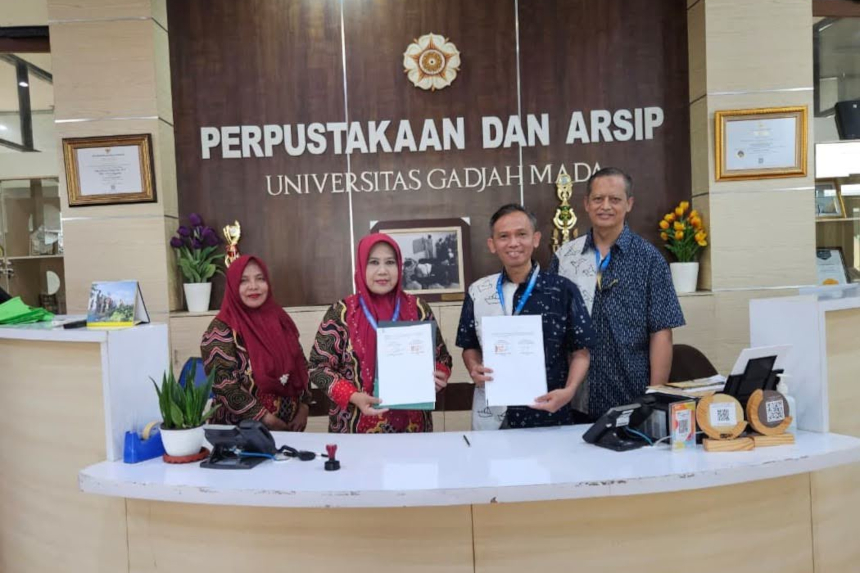 The Head of the UIN Raden Intan Lampung Library, Dr. Eni Amaliah, S.Ag., S.S., M.Ag., emphasized the importance of translating the agreement into concrete and sustainable initiatives. She noted that the partnership offers opportunities to expand the utilization of collections and information resources while enhancing librarians’ ability to deliver services to library users.
“We hope this MoA will be followed by concrete initiatives to continuously improve library service quality. Our main priorities are to optimize the use of information resources through resource sharing and enhance the competencies of librarians and library staff to fully support the implementation of the Three Pillars of Higher Education,” said Eni Amaliah.
As part of the follow-up to the agreement, the two institutions have outlined four areas of collaboration. The first focuses on collection development and access to information through reciprocal access to electronic journals (e journals) and interlibrary loan services. The second concerns human resource development, including internship opportunities and workshops on modern library management.
The third area focuses on digital transformation and information management through the integration of catalog systems and archival preservation initiatives. The fourth covers institutional strengthening and community engagement through accreditation assistance and community service programs involving library development and mentoring. These initiatives are expected to strengthen institutional capacity while improving service quality to better meet users’ needs.
The Head of UGM Library and Archives, Arif Surachman, S.IP., M.B.A., welcomed the partnership, highlighting the importance of institutional collaboration in accelerating library development. He noted that exchanging knowledge and experiences between institutions can provide new perspectives on addressing information management challenges, particularly amid ongoing digital transformation.
“We warmly welcome this collaboration in library development and information management. In today’s era of open access to information, interuniversity networks are essential. Through this partnership, we hope to exchange best practices, strengthen access to information literacy, and work together to address the challenges of digital transformation in the library sector,” said Arif Surachman.
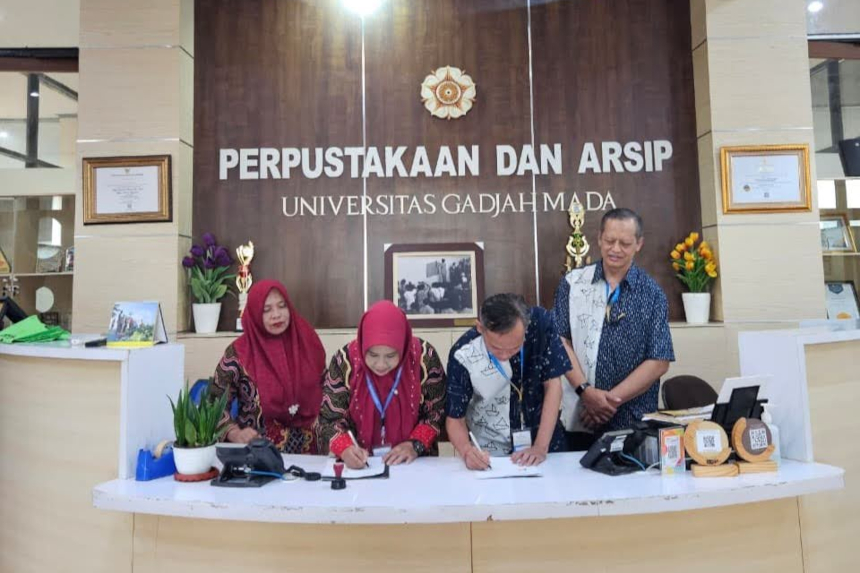 Following the MoA signing, the two institutions discussed potential programs for implementation in the near future. The agenda included opportunities for digital data exchange, training programs to enhance librarians’ skills, and institutional study visits to share insights into library management practices.
This initiative also contributes to achieving the Sustainable Development Goals (SDGs), particularly SDG 4 (Quality Education), through broader access to learning resources and strengthened library staff competencies. Furthermore, the partnership supports SDG 17 (Partnerships for the Goals) by fostering collaboration among higher education institutions to advance library services and information management.
The development of academic libraries requires a willingness to share resources, experiences, and innovations. This partnership is expected to lay the foundation for broader collaboration and generate meaningful outcomes, ensuring that the benefits of libraries extend beyond individual institutions and contribute to the advancement of education, research, and community engagement.
Contributor: Wasilatul Baroroh