
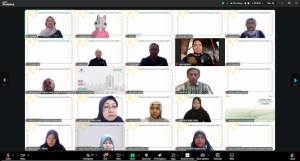
 Digital transformation is prompting libraries and archival institutions to swiftly reorganize their information management strategies. This issue took center stage at the national Ngabuburit Bersama Forum Pustakawan UGM webinar titled “Convergence of Archives, Libraries & Technology: Toward Digital Asset Management (DAM)”, which was attended by hundreds of librarians, archivists, and information technology practitioners from various regions.
The event, organized by the Library and Archives of Universitas Gadjah Mada through Forum Pustakawan UGM, brought together participants from educational institutions, government agencies, and the creative industry sector. The forum served as a platform to share practices and solutions for managing archives and digital content whose volume continues to grow.
The organizing committee chair, Martina Uki Emilyasanti, S.I.Pust., expressed appreciation for the participants’ enthusiasm. “We designed this forum as a shared learning space to help librarians and archivists prepare for the changes in the digital information ecosystem,” she said.
The event opened with remarks from the Head of the UGM Library and Archives, Arif Surachman, S.IP., M.B.A., who emphasized the importance of integrated digital records management in higher education. “Digital Asset Management helps ensure that information is preserved, easily accessible, and able to support education and research,” he stated.
The discussion session was moderated by Maryono, S.IP., a librarian at UGM, who guided the dialogue interactively. The main presentation was delivered by Yogi Hartono, S.Sos., M.M., Head of Quality Assurance & Digital Asset Management at CNN Indonesia, Vice Chair II of the Indonesian Records Management Association (P3RI), and a partner lecturer in Information and Library Management at Universitas Padjadjaran.
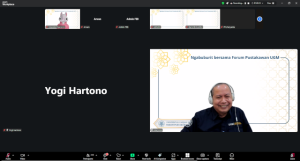
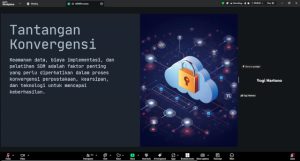 In his presentation, Yogi Hartono explained DAM as a comprehensive system for managing digital assets, covering creation, metadata assignment, storage, distribution, and long-term preservation. “Systematic management makes files easier to retrieve and secure for the long term,” he said.
He also stressed the importance of metadata as the foundation for classification and information retrieval, while encouraging the transformation of librarians’ and archivists’ roles toward digital curation and system-based records management. The discussion proceeded dynamically, addressing priorities for preserving critical archives, initial steps for DAM implementation, and tiered storage strategies.
The Ngabuburit Bersama Forum Pustakawan UGM program is a regular agenda held every Wednesday during Ramadan. The term ngabuburit refers to spending time before breaking the fast with meaningful activities. This forum uses the occasion to host academic discussions and strengthen professional competencies.
The initiative aligns with the Sustainable Development Goals (SDGs), particularly SDG 4: Quality Education, which aims to ensure inclusive education and lifelong learning through improved access to information; SDG 9: Industry, Innovation and Infrastructure, which promotes the development of digital infrastructure and innovative data management systems such as DAM; and SDG 16: Peace, Justice and Strong Institutions, which emphasizes effective, transparent, and accountable governance through proper records and archives management.
Through this regular forum, the librarian community reinforces its commitment to safeguarding the sustainability of knowledge. Structured governance and cross-sector collaboration form the foundation for ensuring that digital assets remain preserved, protected, and accessible for future generations.
Contributor: Wasilatul Baroroh